
Danny Glover
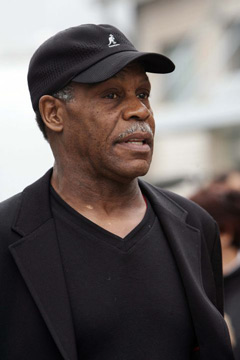


IFQ: Can you speak about the ’60s—the evolution and movement of the Black Panthers and about Cassius Clay who changed his name to Muhammad Ali? Was this when you established your political point of view?
Danny Glover: I think the process of all evolution and culturation happens over a period of time. My first recollection of something happening was when I was 7 or 8 years old. I sat in front of the television and I watched people protesting against racism and segregation, which was around 1954, 1955. I saw that and then I looked back and my parents were watching it and they were interested in it. There was a certain politicalization that happened and within that politicalization, I began to follow them. So every time it was almost like clockwork. I would be in front of the television watching it even though I didn’t understand. I knew these people were doing something that was important because they were brutalized correctively. They were brutalized for trying to do that. They were picked on, policemen attacked them and I noticed something was happening. Then the more and more I began to grow, I began to notice what was happening around me that affected people like me around my age. I began to make clarifications and choices. So in 1963 when I was 17 years old, I remember I saw this boxer (Muhammad Ali) and he was kind of dynamic. He was charismatic. In some ways, he articulated a rebelliousness that I and many other people my age had. I could tell you what impact it had on me. The Black Panther Party was an organization that in ways I was close to because I lived in the Bay Area and was involved in the student movement at San Francisco State 40 years ago. The Black Panther Party was something that resonated. But all these kinds of movements had an impact on my life, just as the music had an impact. I lived in a commune for a year, so all those things were a part of my life.
IFQ: I suppose it was dangerous to be a part of this movement.
DG: You know the history around that. It’s not history that we often romanticize, but some great stuff came out of that. Extraordinary people came out and a lot of people made sacrifices to make those movements come to life and be effective.
IFQ: When you first got into acting, did you think that you would do political roles or films, or were you just happy to get a job?
DG: There is no reference or history of art in my family. I was a student at San Francisco State when I was 20 years old and never been on stage before in my life. We invited this really extraordinary writer of cultural essays to San Francisco State for a semester. LeRoi Jones was his name; his name now is Amiri Baraka. He brought a program that was a part of the black consciousness movement, a movement towards art and not art in a commercial sense, but art as a way of galvanizing, mobilizing a community for change. The first implantation of this idea came as a response to that. I got in one of the plays in 1967. I’d never been on stage before in my life except for a church play where I sang in the choir. I never said a line in front of an audience or made a speech before. I’d never done any of that stuff. I didn’t know what character development was. I didn’t know any of that stuff. And so, I did that and learned something about myself. I learned that I was attracted to the inner life of it and the purpose of that. I will emphasize the purpose of it because I felt that I could become a vehicle for something; I could become useful and use myself as a way of engaging people with a message. That was my first introduction to this whole thing. That was something that happened in a brief period of time. The introduction did not signal the fact that I would find my career in that. So then, I finished school and worked with the city government in communities that were going through transition and marginalized communities. I worked in those communities for six years and programmed community development, education and housing around healthcare. If you go out to those communities now, they remember when I was out there in the early ’70s. So that was the genesis. Then all of a sudden, I decided about mid-way through, about 33 years ago, to start taking acting classes and doing improvisational theatre. Around 1977 when I was 30 years old, I decided that I wanted to be an actor. Then I began to organize my life around being an actor. Eventually I left the job that I had and became an actor.
IFQ: From your experience, what’s the difference between doing independent films and studio films?
DG: For me, usually we are talking about more resources and money when you talk about studio films. I don’t know if I can make differentiations in the way that I approach them.
A studio film is usually going to have a release. The studio films that I have done had releases in thousands of theatres. Independent film is fighting for a point where it can get a release in specific cities. You have to fight for it in different ways to get a release. I knew that when I did Lethal Weapon or The Shaggy Dog or Shooter, they were going to come out in a bunch of theatres. Paramount is going to put out the movie; where the budget is $ 100 million, Paramount’s going to put in $ 20 million of its own. Those are the kinds of things. I don’t know if that’s an economically viable form or model, but it’s what happens. I do know that it has an impact on what you see, the stories that are being told, which stories are anointed and which stories become important. It’s all driven by commerce, but it’s too often driven by commerce. Sometimes someone does an independent film like Saw and makes the film for a million dollars and then it does $ 60 million. That’s an aberration and everybody makes a lot of money off it.
IFQ: You are making Toussaint, which is about the slavery revolt in Haiti in the 18th century. Is it going to have a million dollar budget?
DG: I’ve been preparing and the project is alive. I’ve wanted to do that project for at least 22 years now.
It’s going to be an expensive film, but not as expensive if I had to do it in the studio. It could be three times as much or twice as much as it is [if it was done in the studio]. I figured that if we make a film with a certain budget, then it has a chance to find an audience and could recoup on the investment. This is a film that many people tried to do over the last 75 years. Sergei Eisenstein, who was a great Russian director, attempted to do a movie on the Haitian Revolution 75 years ago. Paul Wilson and Bertolt Brecht wanted to do a movie on the Haitian Revolution. Anthony Quinn wanted to do a movie on the Haitian Revolution.
IFQ: Since you like to focus on political and social issues, you make a lot of documentaries yourself. What are you currently working on?
DG: We are doing another documentary right now on the music of the civil rights movement. We are in the process of doing a documentary on Angela Davis and a documentary on emerging technologies.
IFQ: How are these documentaries going to secure distribution?
DG: I think they are going to have [to be released in] imaginative ways. It depends on the documentaries and if they are going to be theatrical releases or broadcast releases. I have a documentary (Africa Unite) on the celebration of the 60th birthday of Bob Marley. It is music driven and going to have a large kind of CD base and download base and everything else. It’s going to have a theatrical release because of the broadcasters on cable and some sort of ancillaries. It’s a documentary that will have an enormous potential. We spent a little bit over $ 500,000 producing it. That’s one way of looking at it. We have another documentary Trouble the Water, which is about New Orleans that was in competition at the Sundance Film Festival. It’s a unique and different vantage point than any of the other documentaries that has come out about New Orleans.
IFQ: Are you doing these documentaries?
DG: We are doing them. We either raise the money, act as the producers or we develop it ourselves. We came on board with the Marley documentary at the beginning.
IFQ: Who’s “we”?
DG: Louverture Films. You can go on my website: louverturefilms.com
This is a company that I bought with my co-partner Joslyn Barnes, and we formed the company just about three years ago. Those are the films that we are doing, and we are developing one on the relationship between Paul Robeson and Albert Einstein. We have another film that we are doing about an artist from India who becomes pretty well-known in Europe. He was in the lowest caste in India, and then became this extraordinary artist. You can see his art in Paris and around New York. He became lost in this whole transition from traditionalism and the journey and committed suicide at 36 years old in Japan in 2001. So this is a story about him, his tradition and the spiritual intersection of these two cultures. We are also doing a film about photojournalist Muhammad Ali, who covered the world and the Ethiopian famine, which led to the whole “We are the World.”
IFQ: Do you have time to do any more studio films or are you just doing your own thing?
DG: I have a company that is developing these films. I’m very involved in all them. I am attached to them and raise money. It’s like Tom Hanks. He has a lot of stuff on his plate, but it doesn’t mean that he stopped doing the good guy roles altogether.