
Matthew Cherry: The Last Fall and the NFL
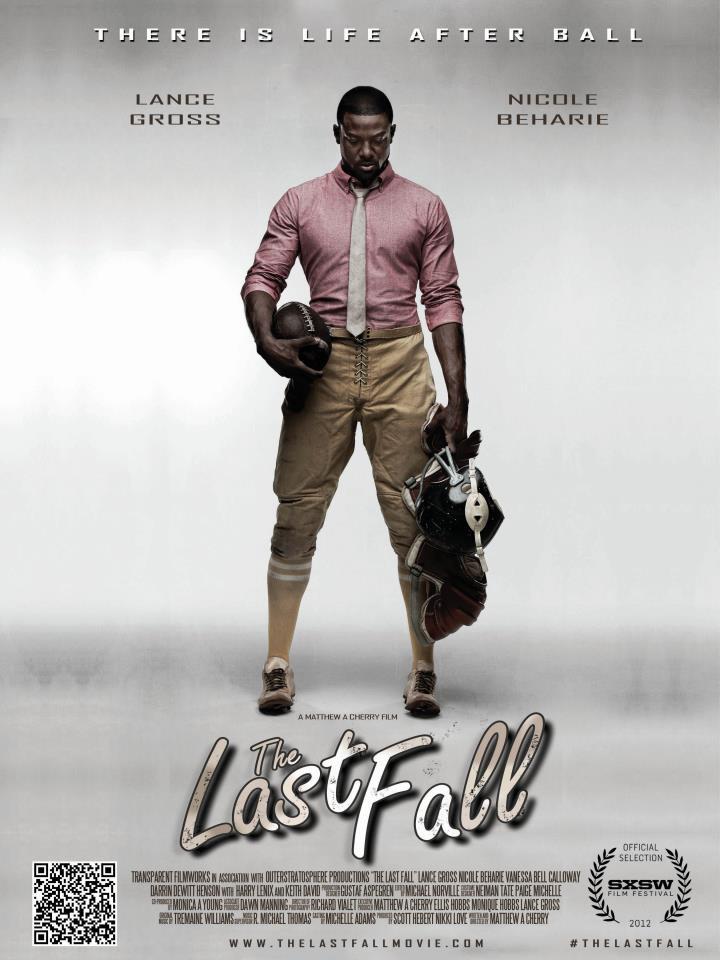


Matthew Cherry, a former NFL wide receiver celebrated the world premiere of his directorial debut at the prestigious SXSW in 2012. “The Last Fall” tells the story of Kyle Bishop (brilliantly portrayed by Lance Gross), an NFL journeyman struggling to deal with life’s complexities after his professional football career is over.
In real life, Cherry was no millionaire and honed his artistic skills in order to make the transition from a pro-footballer to filmmaker. Shooting music videos for Snoop Dogg and Common, working behind the scenes on “The Apprentice” and “The Peoples Court” and producing commercials for AT&T World, Rizzo Design and Washington Mutual are among the projects on his resume. IFQ enjoyed a candid discussion with Cherry about the genesis of the film, the challenges he faced making his celluloid dream reality and his unique strategy to attract investment and build a buzz.
Independent Film Quarterly (IFQ): Why did you decide to make a feature film instead of a documentary about the reality of a professional athlete’s life after the NFL?
Matthew Cherry (MC): When I moved to LA after retiring from the NFL, I worked on a lot of scripted narrative sets, TV shows, commercials, etc. and that is the format that I felt most comfortable telling my story in. I do think there is a strong documentary component to this topic as well and it is something that I may explore one day.
IFQ: How did you get started making your first feature length film “The Last Fall”?
MC: I was shooting a short documentary about the NFL Lockout last year and for this project we traveled from city to city and interviewed a lot of fans and business owners. One of the main questions we asked fans was “Who do you blame for this potential lockout, the player or the owners?” Surprisingly many fans blamed the players. They called them “greedy, selfish and arrogant and said that they shouldn’t care if they make 8 or 9 million dollars, because it was more than they would ever see in their lifetime, had it not been for football.” As a former journeyman player who was on the practice squad my rookie year, I found myself constantly defending the players and explaining that it’s not really like that for most players. I saw a void and a huge misperception and I wanted to fill it.
IFQ: Who or what influenced your decision to enter filmmaking after you retired from the NFL?
MC: First and foremost my Communications degree from The University of Akron, secondly when I first moved to LA, I went through this program called Streetlights. Streetlights is a non-profit organization that trains men and women of color as production assistants in the not-so-diverse worlds of film, TV and commercial production. By participating in the program, I gained access to various production sets and began to understand that I could really do this (film production).
IFQ: How was the transition, and what steps did you take to reinvent yourself from professional football player to filmmaker?
MC: The transition was extremely difficult. I’ve played football ever since I could walk and here I was 25 years old with a majority of my life staring me in my face. I had to move back home; my car was repossessed at one point. I was broke and I was depressed. When I moved to LA, I had to reinvent myself. I never spoke about the NFL to anybody. I didn’t want anyone looking at me like I was privileged or that I was just coming into the business to throw money at it. I wanted to learn and I wanted to do so from scratch, so I took the time and studied, did the research and learned on set. That was my film school.
IFQ: Was Lance Gross your first choice to play Kyle? Why?
MC: Yes, Lance Gross was my first choice to play Kyle. Lance is talented and incredibly hard-working actor with all the variables. He has the look, the hunger and the personality. Kyle Bishop is not your typical football player. He wears his heart on his sleeve and is very vulnerable and it was important to me to cast an actor who was believable but also was somebody that audiences could empathize with.
IFQ: What was the most challenging obstacle that you faced during production?
MC: The biggest challenge was the passing of my mom three weeks into pre-production. She passed away from a heart attack at 57 years old on May 21st, 2011. At the time we were going to be this super tiny independent film production with a budget of round 25K. The day before my mother passed, I lost my phone and I wrote her an email trying to get the password. We weren’t close like that; we probably talked every couple of weeks. For some reason I felt compelled to express myself more and I told her that I loved her, and that I appreciated her looking out for me while I was living in LA, sending me money and assistance whenever I needed it. In the last line of my email, I told her that I was working on something big and that if everything went well I would be able to buy her that house that I wasn’t able to buy her when I was playing in the NFL. That next day I got word that she passed and I had to move back home. At the time I didn’t know that my mother had life insurance, as she worked as a legal secretary for over 30 years, but when I got word that she named me and my sister on her policy I couldn’t think of anything else to do other than make this film which was the last thing I told her I was going to do. I ended up putting her life insurance into the making of this film and that along with our funding from our Executive Producer, former NFL player, Ellis Hobbs is how we were able to get the film made for just less than 200K. That was the hardest part of production for me because in a way my mother is a real life angel investor and I can’t look at this film without thinking about her or my father who also passed away during the filmmaking process.
IFQ: Very sad to lose both your parents. It must have been a very difficult time but good that you kept focused. How did you hook up with your Executive Producer Ellis Hobbs?
MC: We did an Indiegogo campaign initially trying to raise $16,832 for pre-production. Me and my producing partner at the time Scott Hebert shot a video in his apartment that basically explained the movie’s concept and released it on twitter. We sent the link out last April, and two days later a woman by the name of Monique Hobbs hit me up and said that she never clicks on these links but for some reason she felt compelled to. She said that her husband Ellis Hobbs played in the NFL and was about to retire and that this story interested her. She also said that they might want to back the project fully. I never knew she was following me on twitter. It was by God and by chance that we linked up. It was totally unplanned. After sending her the script she connected me with her husband and the rest is history.
IFQ: Can you tell us more about your use of crowd sourcing on IndieGoGo and KickStarter? Any tips for independent filmmakers who want to use that platform?
MC: KickStarter helped us secure some funding to finish up the movie before our SXSW premiere. The main advice I would give to indie filmmakers, especially now that it has become so popular, is that crowd-funding should not be the first time people are hearing about your project. Shoot a trailer, approach people for finishing funds but don’t try to launch a KickStarter campaign without awareness or interest from your audience.
IFQ: How did you go about securing North American distribution through Image Entertainment? Have you secured foreign distribution?
MC: We have not secured foreign distribution yet but we did secure non-theatrical distribution through Image Entertainment. Our producer Monica A. Young and our sales rep George Rush had a relationship with someone within the Image Entertainment family. We sent them a screener and the SVP Brett Dismuke got back in touch with us and said he was interested. We had several offers out of SXSW but this was the best situation for us. The deal was in the works for several months before we announced it at ABFF this past June. We ended up with one of the biggest deals for a film that premiered at SXSW.
IFQ: Your film had its World Premiere at South by Southwest (SXSW) Film Festival. Can you tell us about your experience at SXSW?
MC: SXSW was a great experience. Producer Janet Pierson is incredible and she was a champion of our film from day one. We were actually the first feature film to play at the festival. We had four sold out screenings and it was a great experience. Film festivals are important because they create awareness for your project. While SXSW is not a “market” festival, there were some buyers there and we had some offers for distribution from screening at that festival.
IFQ: Can you tell us about your company Cherry Entertainment?
MC: Cherry Entertainment is all about visual story telling. We shoot music videos, web series, short films, feature films and eventually TV shows. The company is dedicated to the memory of my parents.