
Ray Stevenson
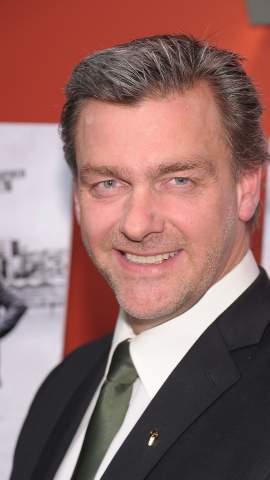


Ray Stevenson first came on the scene as the lead in HBO’s Rome. Since then, he has managed a steady stream of work as a vital part of ensemble casts in Cirque du Freak, Book of Eli and The Other Guys.
In March, Anchor Bay released Kill the Irishman –the true story of Danny Greene (played by Stevenson), a tough Irish thug working for mobsters in Cleveland during the 1970s. In May he will star as Volstagg in Paramount’s Thor and then in the Fall as Porthos in Summit’s 3D The Three Musketeers. It’s confirmed: 2011 is the Year of Ray Stevenson.
Independent Film Quarterly’s David Fletcher recently sat down with Ray Stevenson inside his suite at The London Hotel in West Hollywood, CA.
IFQ: Can you tell me a little bit about your character in Kill the Irishman?
Ray Stevenson: Danny Greene! When I first read the script, I thought something resonated. I heard this story before somewhere. Then I remembered three or four years previous, I saw American Mobsters. This particular episode was about Danny Greene. I remembered the live footage, the bits of Shondor Birns car after his demise, and Cleveland at that time and tracking his life. It’s such an amazing slice of Americana. It was a period when cars didn’t get any bigger, lapels didn’t get bigger, mustaches didn’t get bigger. Actually, the criminals didn’t get any bigger. Danny Greene was larger than life. He used to wear a Lincoln green suite and green pants. He was in your face. What you saw was what you got. After this period, everything went a bit more sophisticated, underground and unseen.
IFQ: I grew up in the New York/New Jersey area and there is a large Irish American presence there, as well as Boston, etc. Were you aware that Cleveland had this type of Irish mafia going on?
RS: No. I didn’t. In fact, in the story it was Italian mafia run and out of New York, Detroit, Cleveland, that whole sort of sweep right up to Montreal. What I love about the story is that it’s a man’s journey; it’s a criminal’s journey. He’s a villain; he’s a mobster; he’s a racketeer, but aspiring to affiliate himself with the mafia and becoming the head of the Longshoremen’s union. He rounded up Irish American affiliates and set up his Irish crew and literally went to war with the Italian mafia on the streets and turned Cleveland into the bomb capital of the U.S. in ’77. 32 or 37 bombs went off. These were serious car bombs and there was blood on the streets. It’s such a slice of that period in American culture and history.
IFQ: The film was actually made in Detroit?
RS: Yes. We were intending to check out Cleveland, but Cleveland sort of has tidied itself up. Cleveland, at that time, would’ve resembled Detroit now.
IFQ: Going back to characterization, what kinds of things did you do to prepare yourself for this character?
RS: There’s a lot of information written, a lot of documented biographical history and there’s even some TV clips. You get a flavor for the guy, but we’re not making a documentary. You’re actually making this man’s journey. Basically, it’s getting inside the truth of it. He was a violent man. He did violent things to violent people, but I had to really explore this man’s journey and how he operated and the friendships he made and yet he was still doing criminal and violent acts in this period. It’s not about getting up there and thinking, I’m going to be this violent, hard person today. He was a very well read and self-educated man. He was a very street wise intelligent guy and he could run businesses left, right and center. He saw opportunities and again, in a criminal way. He guarded respect and friendships around him as much as he guarded distaste and dislike. He was known as the Robin Hood of Collinwood. He would send food around to families who couldn’t afford it. He would pay rent for people. He would basically take care of the local community in his own way. When his house was demolished, the local people came out and helped clear the rubble away. It wasn’t because they were under threat or anything. It was because, yes, he’s a villain but he’s our villain. He was a part of the fabric of the neighborhood and everybody was having it tough, but he was just a larger than life character on the block, really.
IFQ: As an actor you brought out the good in this character.
RS: Well, good and bad are always very subjective. I don’t give a damn if you like the character or not. Do you believe him? If you believe, then my job is done. It’s not to make him likeable or not. In fact, there’s a line in the story he has with the character played by Fionnula. He says, “ There’s no good in me.” She says, “Ah, you know Irish— we are liars, we’re thieves, we’re fighters, but there’s a bit of good in every Irish man.” This is the strength of Hensley’s script and the amazing cast was drawn in by this writing. Who doesn’t want to play this?
IFQ: You are a successful film and television actor; what advice would you give to young actors out there?
RS: There are two things I want to say. First, Richard Burton was asked this by a young aspiring actor and Richard Burton looked at him and said, “You have green eyes; I have green eyes; I think you should try it.” He did try it—that was Kevin Costner. Another one is that if you have to ask, don’t even bother. It is the most wonderful profession in the world, but if you don’t love it don’t kid yourself. Basically, if you’re going to be an actor you’re going to be an actor—that’s it. If you can make a living being an actor, you’re a successful actor. If you can make a living being an actor and that’s not enough to satisfy you than you’re going to have a miserable life and you’re going to make everyone around you miserable. Be a producer and then you can justify making people miserable.