
Big Eyes
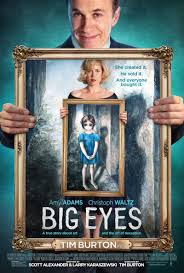


Big Eyes is a biopic, as well as a social commentary, that gazes into the life and career of the unusual artist, Margaret Keane, who is also woman during the 1950’s, an undeniably male-driven time, leaving her to fight for the ownership of her very own works of art. Tim Burton directs the film that was conceptualized by screenwriting team, Scott Alexander and Larry Karaszewski, who were inclined to tell Margaret’s story of art fraud, deception, and the importance of standing up for what is yours.
Amy Adams plays Margaret Keane, a single mother and aspiring artist who escapes her first husband and rushes off to San Francisco in the hopes of starting new, and she eventually does, after meeting the charming Walter Keane, played by Christoph Waltz, who Krysten Ritter, Margaret’s only friend, proclaims has “Diddled every skirt on the art circuit.” Yet Margaret does not buy into her friends concerns. Instead she defends Mr. Keane, desperate for financial comfort, and the fresh-start that she seems to believe only a man can provide both her and her daughter. In this film, Adam’s comes across as sweet yet dull. There are forever tears in her eyes and we’re left wondering if her relationship with Walter is based on anything real.
Walter, a self-proclaimed artist and realtor, does not produce any works of his own, especially in front of Margaret who is prolific, drawing children with oversized faces and big sad eyes, over and over again, as if inspiration never leaves her, as if producing multiple paintings in one day is a non-issue. Still, we believe in Margaret’s productivity, and her talent. We want this extraordinary but desperate woman to succeed. We are, however, skeptical of Walter’s abilities, and his agenda.
Christoph Waltz plays a man who is sociopathic in his behavior and his performances are grandiose and overdone. We grow tired of watching him prance around the room, waving his hands and whining as if he were a prepubescent boy. Also, there seems to be no chemistry between Waltz and Adams, especially sexually, and it comes across as if there is an underlying joke between their interactions. The lack of compatibility between the two actors is almost humorous, leaving us wondering what Tim Burton’s aims were when directing this film. Is the director capable of seriously depicting a story concerning the complexities of a relationship between two adults? Or does he choose to shy away from that, and instead compensate by overstating visuals and scenes?
The true story comes through when we uncover Walter’s abusive tendencies. He belittles his Margaret, claiming her art as his own when club-goers and socialites admire her paintings in a dull corridor. Instead of setting things straight, he economizes on the idea, going back to the club without telling the truth about why he’s making cash, until Margaret shows up one night, sees him in action. That’s when we’re given a greater glimpse into Margaret’s character. Will she stand up for herself and her art, or will she perpetuate Walter’s lies by acting as an innocent bystander? To our dismay, Margaret does not speak up. Instead she hides, leaving Walter to continue bathing in his glory, and her to stand in his shadow. She gives up too easily, and it’s almost too hard to believe. Yet we continue watching the film, in the hopes that there will be a payback.
We see Walter Keane become a mastermind when marketing Margaret’s works, creating versions that are accessible in supermarkets and stores. Without Walter, we are left wondering if Margaret would have ever been known, which makes her character even weaker. She is indeed the artist, creating the children with the big eyes, but Walter is the one showing them to the world, and Margaret has been hiding. Yet we know that what Walter is doing is wrong. We recoil upon seeing him belittle his wife who he desperately wants to be. Now the question is, will we sympathize with Margaret, considering that she may feel helpless, and threatened by her overpowering husband, or will we or feel that her character is a total let down?
There is a turning point in the story when Walter reveals, after years of marriage, that he has a daughter, amongst other secrets. He slips up during interviews and is not able to describe his artistic process. Newspapers smash the works that are not his, and he becomes angry, volatile. He tries to hurt Margaret and her daughter by lighting the room where they are hiding on fire. We believe in Margaret once again when she escape’s to Hawaii, and finds the support she needs after becoming a Jehovah’s Witness.
It is on a Hawaiian radio station where Margaret Keane decides to tell the truth about herself, and her husband, leading to a court case where they both show up, and the only way to figure out who is indeed the artist behind the children with the big eyes is for them both paint at the same time. Mr. Keane gives extravagant speeches. His character is ostentatious and sly, but in this courtroom, no one is fooled, unlike others had been in the past. Finally, justice is served for Margaret, and it comes through what she’s had all along, artistic ability and strength. All she had to do was find the confidence to claim herself.