
Broken Flowers
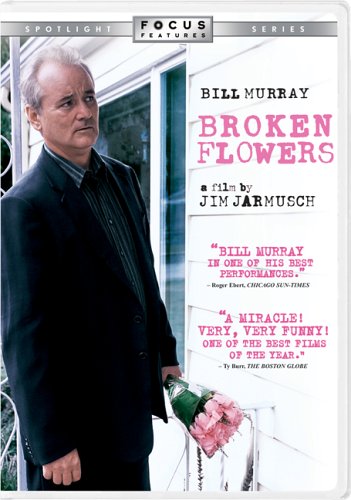


Don Johnston in Jim Jarmusch’s “Broken Flowers,” is the latest addition to this resume. The film begins with Don finding himself on the outs of another romance this time with a woman name Sherry (played by the criminally underemployed Julie Delpy). Don responds to the breakup with resignation rather then indignation, and quickly collects his mail in order to go visit his neighbor.
His neighbor Winston (Jeffery Wright) is Don’s opposite. Winston has a wife, five kids and three jobs. He believes in commitment…a lot. Winston is also an amateur detective, and is prone to the kind of investigation that Don is less inclined to get involved with. When Don shares an anonymous letter typed on pink paper, revealing that he may have a son looking for him, his first reaction is to ignore it completely. Winston, however, chooses to launch a full-blown investigation in order to reveal the woman’s identity.
Don begrudgingly complies by compiling a list of women who may or may not be the anonymous mother. Don feigns disinterest, but allows Winston to begrudge him to take a trip and reunite with the women from his past (who include Sharon Stone, Tilda Swinton, Jessica Lange, and Frances Conroy).
The premise reads like a more emotionally wounded “High Fidelity,” but Jarmusch’s pension for minimalism keeps the film from veering too far into its mainstream tendencies. “Broken Flowers,” feels like a more natural progression for Jarmusch then “Coffee and Cigarettes,” as that film seemed only to justify it’s own existence by showcasing how very indie it was.
He also finds the perfect playmate in Murray whose ironic soulful ness mirrors his own. Murray adds unexpected sweetness to his encounters with his women. He’s a commitment phobe, but also undoubtedly an aging romantic. While many other actors would play off the encounter with Stone and her daughter (named Lolita) for pure laughs he’s able to find the core of his character’s initial attraction.
When he encounters his old flame Dora (played with the sexuality of a sex kitten librarian by Frances Conroy) he observes an old photograph of her from a time when they were together. “I took this,” he smiles at her. Don seems to be a man whose been collecting and falling in love with different parts of all the women he’s encountered in his life. Loving them in such diverse ways that it becomes next to impossible to dedicate himself to one woman entirely. Now, however, it’s beginning to take its toll.
The title “Broken Flowers,” tends to denote a shattered kind of romance. Don envies his friend Winston, but doesn’t know how to be the man he wishes he could be. He loves women in part, but never entirely and even his final encounter with a young man who may or may not be his son is met with the same frustrated obstruction between the man Don is and the man he hopes to be.
There is a lot in “Broken Flowers,” that feels familiar. The aging Don Juan, the midlife crisis, and estranged son are found in equal measure in an equal number of Hollywood films. “Broken Flowers,” succeeds however due to the professional cool that Jarmusch and Murray are able to maintain. Even while some of their tricks may be becoming increasingly familiar, their talent and artistry to play with people’s expectations is still not to be missed.