
Clint Eastwood’s Jersey Boys – In it for the songs
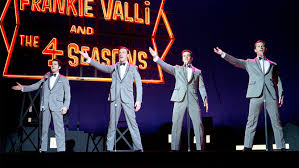


In a departure from his usual intense film projects, Clint Eastwood directs the musical biography, Jersey Boys, chronicling the success of iconic all-boy band, Frankie Valli and The Four Seasons. The film was produced by Warner Bros. and released theatrically on June 10th to very mixed reviews. Your writer, being a fan of Mr. Eastwood, his films as well as oldies, was delighted to see it on her review list – so here’s the good, the bad and the doo-wop!
This is a tough acting gig with outstanding musical talent tantamount to its success. It’s admirable that Eastwood largely chose a cast of Hollywood unknowns. Tony award-winning actor John Lloyd Young landed the role of Frankie Valli. Of course, it helped that his two year stint as lead vocalist on the Broadway smash of the same name was very successful. Lloyd Young certainly has an amazing falsetto and the boyish good looks to pull off Frankie Valli but his acting talent is slightly less convincing. Vincent Piazza (Boardwalk Empire) plays beleaguered Tommy DeVito, the band’s founder and lead guitarist who later on would become a major fly in the ointment. Piazza was particularly good especially as he had no musical experience. New York actor and ex Jersey Boys cast member Erich Berger was equally good at portraying genius singer/songwriter Bob Gaudio, whose compositions such as Sherry changed the direction of this falsetto group entirely. Gaudio also had confidence and a great head for business and was able to steer the band away from Devito’s destruction and shady dealings with loan sharks such as Norm Waxman, convincingly played by Donnie Kehr. Michael Lomenda snagged the role of Nick Massi, the least charismatic band member yet talented enough to pull off the demands of bass guitar and catchy harmonies.
Additional cast members include Michael Doyle who turned out a solid performance as hammy music producer Bob Crewe, who acknowledged the band’s unique sound (then The Four Lovers) when other fickle A & R’s rejected them. One of the film’s best scenes shows the group entering the legendary Brill building in NYC. Christopher Walken was believable as Angelo “Gyp” De Carlo, a charismatic mob boss with an interest in the band and a soft spot for the young Frankie who grew up living by Mafia codes such as “Don’t Squeal on a friend.”
Thankfully, once we reach the part where the band get discovered, the music is superb with one killer hit after another. According to Eastwood all of the songs were performed live by the cast: Sherry; Big Girls Don’t Cry; Let’s Hang On; My Eyes Adored You; December, 1963 (Oh, What a Night); Candy Girl; Bye-bye Baby; Can’t’ Take My Eyes Off You; Walk Like a Man; Who Loves You and Rag Doll among others. The boys went from harmonizing on street corners in Newark and singing in smoky lounges to becoming one of the biggest pop sensations of the 60’s and 70’s. Curiously in this film, it is not that clear just how successful they became before Frankie went solo.
The film’s production value was impeccable and cinematography by vet Tom Stern captured all the nostalgia. Similarly, costumes, props, set design and make-up all looked authentic enough and helped to elevate the film’s status as a period musical.
However the lack of character development, a clichéd script and heavy stereotyping are the film’s weakest links and end up doing a disservice to a great untold story. Perhaps it was a case of too much ground to cover especially when tackling the darker elements of the Jersey Boys such as prison sentences, gangs, contraband and financial problems. The vicissitudes of fame and fortune, especially with bands, is usually synonymous with wealth, power, decadence, affairs, breakups, greed, inflated egos, in-fighting, artistic differences and neglected families. All of the aforementioned are squeezed into the story and ends up playing more like a period soap opera – it might even be embarrassing for the families.
Eastwood focuses on the theme of fractured families and the consequences of showbiz life. Renee Marino as Mary Delgado, Frankie’s first wife was portrayed as a bitter neglected alcoholic. Emotionally, the film really comes to life in the third part with the most poignant scene being the untimely death of Francine (Frankie’s youngest daughter) from a drug overdose in 1980. In a touching coffee shop scene, we learned, out of nowhere, that Francine had a great voice, and, in an attempt to put her back on the right track, daddy offered to get her voice lessons. Whilst the role was very well played by Freya Tingley, it was surprising to see this connection as it was not well explored in the film. A devastated and guilt-ridden Frankie took a career break, and with gentle coaxing from Gaudio, came back stronger than ever with the 1967 smash Can’t Take My Eyes Off You, co-written by Gaudio and Crewe.
As in the Broadway show, Eastwood uses the cast members to narrate and weigh in on events as they unfold. This technique felt too random and did not necessarily make the film more cohesive. Eastwood avoids looking deep into the characters to explore what really motivated the fascinating quintet of working class origins. Whether or not he was an artistic fit to helm this biopic, Eastwood, himself a talented jazz composer, nailed the library of songs that are adored by millions.
As the film reaches its conclusion, the original band reunite for their induction into the Hall of Fame in 1990. Then cut to the finale where the entire cast dance and sing as if they were at a street party in Jersey. In spite of its shortcomings, Jersey Boys should appeal to all ages and is a cert to garner noms at upcoming award shows.