
Closer
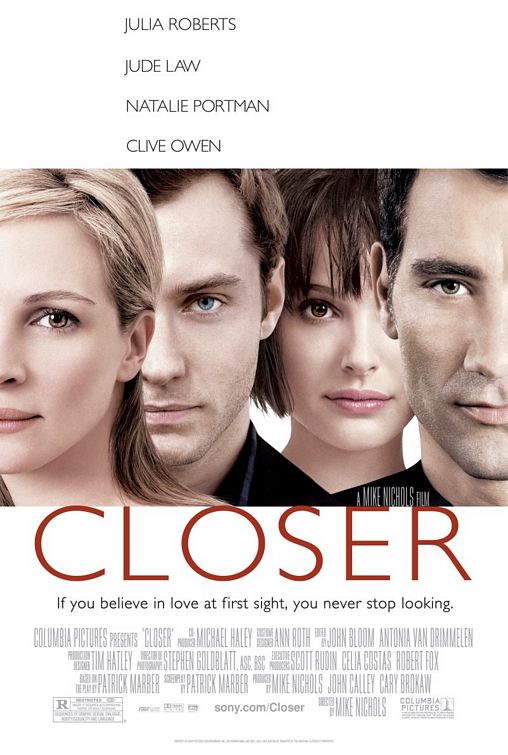


Law plays Dan. A mousy obituary writer, turned suave novelist, turned love struck thirteen year old (all in the space of two hours). His first affections are for Alice, a plucky American stripper (played by Natalie Portman) who gets run over by a car in the opening sequence of the picture.
Dan leaps to action taking Alice to the hospital and while in the waiting they partake in a kind of pseudo first date. Dan and Alice play to all the cues of emotion. Flashing darling smiles at each other, and looking away in embarrassed sheepish ways. Their attraction, however, lacks sincerity. By the end of the film it becomes apparent that these two need to be in love, more then they actually need each other.
Dan writes a novel and goes to have some publicity photos taken by an American named Anna (stoically played by Julia Roberts). She photographs Dan who has now shaken his Clark Kent persona, in exchange for some hair gel and a black button up shirt. He eyes Anna in a much more predatory fashion, and circles as if the repellent were not consent but merely timing.
Anna accepts then rejects his overtures. Dan seems interested in Anna merely because he believes her to be an upgrade from Alice, and Anna seems uninterested only so she might appear interested.
Anna meets Larry (played by Clive Owen) because of Dan. Dan meets Larry in a chat room, and insists he is an attractive woman named Anna who likes to frequent aquariums. While Dan means this to be an embarrassing encounter for Anna, Anna and Larry forge a courtship that then leads to marriage. Anna seems to be doing this out of spite for Dan, and Larry seems too focused on himself to notice that Anna’s affections are otherwise engaged.
The film “Closer” however offers no true affection so it can offer no true jealousy. The most frustrating part of closer is trying to identify anything there is to identify about the characters of “Closer.” They are not so much people as vague opportunities. Simultaneously transforming into adulterers, cynics and romantics. They exist without a present or past, family or friends, but merely take shape according to the other’s desires.
The frank and honest dialogue by Patrick Marber, in actuality, seems neither frank nor honest. It seems, instead, to be in a rather New York state of mind, and rather cold and distant from any universal transcendence of sexual jealousy and confusion. Nichols’ adaptation of Marber’s play suffers the same claustrophobia that most plays that make the leap to screen suffer from, as well as the fact that what makes a provocative play doesn’t necessarily translate to a provocative film.
In the end “Closer,” fails because it fails to draw us in. Mr. Law is too inconsistent in his performance, and Ms. Roberts follows the rather unfortunate decree that Comediennes must shed themselves of all humor and warmth in order to be taken seriously in a serious drama. Mr. Owen and Ms. Portman do admirable jobs, but in the end they can’t save a film that promises to pull us in, only to push us away.