
Fever Pitch


Hornby is the famously well-intentioned voice for male pop cultural soullessness. In “High Fidelity,” Mr. Hornby dealt with men whose love for their significant others couldn’t rival their love for original Velvet Underground EP’s or spending the night comparing top five favorite side one track ones competing to see who could name the mostly highly acclaimed but poorest selling band. In “About a Boy,” we follow the trials of a man who sees no need to get a live of his own when there’s such an abundance of life around him, all that really required is that he attach himself for a limited time. “Fever Pitch,” was his collection of personal essays regarding his love of soccer and of the Arsenal and how that nearly costs his relationships every time.
Hornby’s books are wonderful male confessionals about borrowed emotions. Whether the emotion be the quite melancholy of Lou Reed singing in the microphone for a song like ‘Heroin,’ or sharing the ecstasy of watching your favorite athletes win the big game, Hornby’s novels mostly deal with men who want to get the pleasure of life without having to deal with the sacrifice. It is this element that makes Hornby novels so addictive and it is also unfortunately, this element that is so readily sacrificed in order to make the latest Drew Barrymore romantic comedy, “Fever Pitch.”
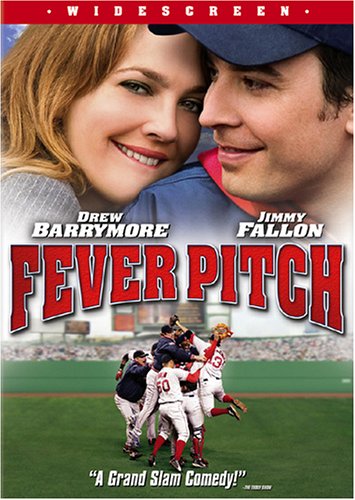
Barrymore plays the high-powered Lindsey Meeks, who has the good job but like all post modern feminists yearns to find a good man. Enter Jimmy Fallon’s Ben Wrightman (right man…get it?). Fallon basically has the over eager boyishness of what you might expect a grown up Pinocchio might have, after being given the chance to become a real boy. Fallon has a refreshing screen presence, but Barrymore being the veteran of so many romantic comedies is the professional here.
Ben meets Lindsey on a school field trip where Ben is trying to show his most promising Math students the benefits such achievements can have in the real world. Ben meets Lindsey in October (timing being important here) and they begin a world wind romance that carries them to the spring.
Ben is charming, funny, and considerate so Lindsey’s friends are tempted to ask, “What’s wrong with him?” The argument being that no man being over thirty can achieve both having never been married, and being currently single without some sort of major defect, and when Lindsey asks Ben to go home with her to meet her parents she finds out, Ben is a Boston Red Sox fan.
After being struck by a baseball at game, however, and seeing that Ben was more intent to congratulate the guy who caught the ball rather then see if she was alright, she’s tempted to rethink her original conclusion.
It is then we go through the familiar romantic comedy scenario of ‘will they or won’t they?’ Fallon and Barrymore serve admirably, but the film mostly suffers from its own need to hold itself back.
The film is directed by Bobby and Peter Farrelley who for some reason have decided to put on their best table manners, and have mysteriously washed the film of all signature traces of their outrageous talent. In the end the film inspires chuckles, rather outbursts and doesn’t really stir much emotional engagement. For a film so saturated with male themes and male voices “Fever Pitch,” is surprisingly unfettered by any grazing of the male psyche. In the end “Fever Pitch,” goes down like an all star game. Familiar enough faces but without any real point or consequence.