
Good Night and Good Luck
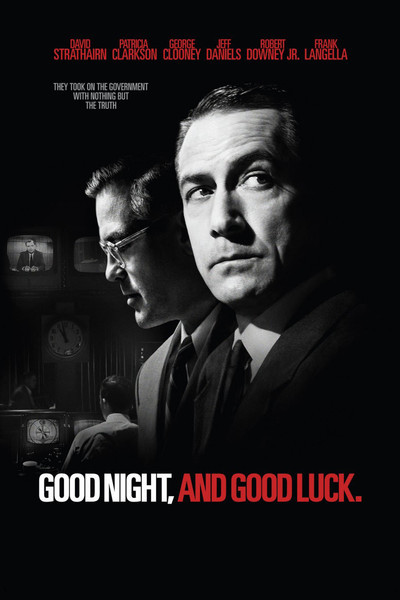


George Clooney’s “Good Night and Good Luck” starts off with an effective dupe. Edward R. Murrow (played by David Strathairn) begins the film accepting an award from the Broadcast journalists of America. He takes the opportunity to besiege his colleagues for the escapist and materialistic waste bag and indeed American culture have become. For a moment Mr. Clooney leads us to believe that despite the fact that Mr. Murrow’s words were spoken over fifty years ago, they may be just as relevant today as when they were first uttered. That in an age when the approaching season of American Idol screams with more immediacy then a forthcoming withdrawal plan from Iraq, the life and times of Mr. Murrow might provide some kind of useful critique on our current state of social apathy. As “Good Night and Good Luck” progresses, however, this notion is quickly abandoned.
The film concentrates on Mr. Murrow as he gears up to take on Joseph McCarthy. Hollywood has long held to the belief that any time the current social climate seems to be squashing progressive political debate, an allusion to McCarthyism is always in order. However, the comparison no longer seems timely, as debate over Iraq has turned from divisive to wearied, nor accurate.
Edward R. Murrow’s broadcast of “See It Now”, which specifically dealt with Joseph McCarthy and his tactics aired in March of 1954. McCarthy began his anti-communist crusade in 1950. When he began his ill-fated investigation into Communist influences in the Army in the fall of 1953 his downfall began to resemble a snowball rolling down a very steep hill. Mr. Murrow’s broadcast was certainly the most successful confrontation of McCarthy, but hardly the first of it’s kind. Broadcasters Elmer Davis and Martin Argonsky took McCarthy on much earlier, to much greater detriment to their careers.
The Murrow broadcast came at a time when people in McCarthy’s own subcommittee and even President Eisenhower were working to remove McCarthy from a position of power. Moves they could only make due to his waning public support. The broadcast as it was then, suffers the same perils that the film does now. It played for an audience that was already likely to agree with it.
It is the historical context of the story that robs it of any real dramatic crackle. The film is smartly written and performed, especially by a sterling performance by Mr. Strathairn, and Mr. Clooney shows his first signs of directorial flair but his heroes spend the entirety of the film in search of a foe. His charactersâ’s subplots (especially one involving Robert Downey Jr. and Patricia Clarkson) have similar trouble finding some dramatic traction.
Mr. Clooney’s love letter to Mr. Murrow works best as a eulogy to ethical standards in broadcast news and journalistic integrity. Mr. Clooney seems to understand that the honesty and integrity that Mr. Murrow was so renowned for, would only be dismissed as purely partisan tactics in today’s highly divisive political atmosphere, in which everything which can’t be used for political gain is usually chalked up to underhanded tactics by the other side.
Mr. Clooney’s “Good Night and Good Luck” shows the potential to be a dramatic powerhouse, but mostly trips up on it’s own good, pseudo-controversial intentions. It’s a competently made and entertaining film but one that’s ultimately never as important as were first led to believe.