
No End In Sight
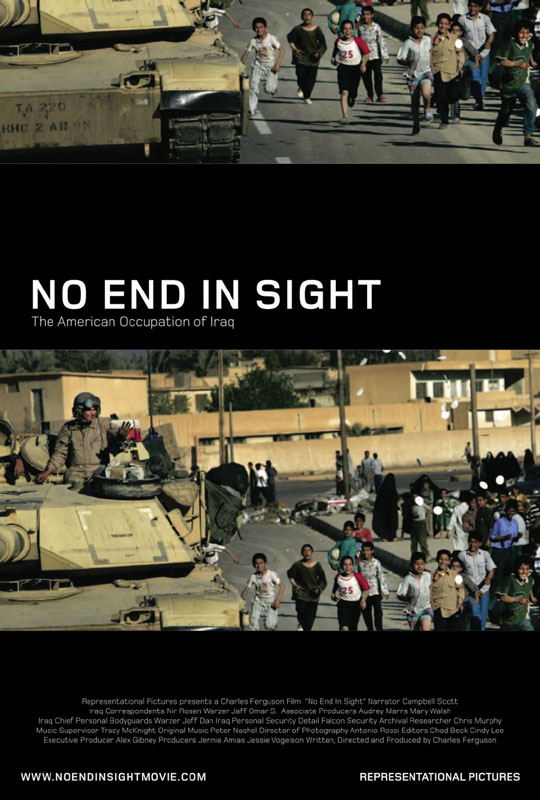


Incisive and poignant, these are two words among many that can describe Charles Ferguson’s Iraq documentary No End in Sight. Released by Magnolia Pictures, the film is one of the first major cinematic documents focused on chronicling the systemic breakdown of civil order in Iraq leading to insurgency. The first notion that has to be dispelled is that the film is your standard sort of agitprop that the Michael Moore’s of the world and his counterparts flood the marketplace with. Unlike his ideologically-driven contemporaries, Ferguson takes a cold, methodical stance on investigating what went wrong and how what was supposed to be an opportunity for freedom so quickly descended into bloodshed.
If one were to find an overly simplistic equivalent to the film’s structure, it would be connect the dots. And that is the key idea to remember when both viewing the film and taking in the information it provides the viewer; our current political and military quagmire is the result of a long line of administrative blunders and missteps that cumulatively, not individually, sowed the seeds for the current civil war. Ferguson takes us back to before the war even begun to point out the first costly mistake, namely the lack of time and preparation put into the postwar reconstruction plan. Pointing out that during World War II Allied leaders had spent two full years planning the postwar governing of Germany after hostilities ceased, U.S. officials were given two months to do exactly the same task. Key officials from that time period including General Jay Garner (in charge of Iraq’s occupation up until May 2003), Ambassador Barbara Bodine (in charge of Baghdad in early 2003), etc. are interviewed on camera, speaking about the lack of time, material, and cooperation they worked with in trying to cobble together a strategy needed to govern a country of millions about to be overturned, politically and socially.
From this initial lack of foresight in preparing for a postwar government, the film then moves forward in time to early 2003 when President Bush announced that all major hostilities in the country had ceased and declared victory. In the following month, rampant rioting flooded both the streets of Baghdad as well as the country at large. Cultural centers were destroyed, business and government facilities were destroyed, and most importantly American troops stood by and allowed these activities to occur virtually unchallenged. This is often pointed out as being the first seed in Iraq’s insurgency because without martial law being declared, civil order disintegrated. Next, when Ambassador Paul Bremer arrives in Iraq to act as the head of the American provisional government, he sets into play a series of decisions that would further break apart what small administrative cohesiveness was left.
The most damaging decision made turned out to be, in hindsight, disbanding the Iraqi military; a decision strongly opposed by both U.S. officials working on the ground as well as U.S. armed forces that was apparently made by Washington politicians who had never set foot in the country nor served in a military capacity. Reconstruction officials knew that in order to provide a proper security force able to police the population and secure the borders, the Iraqi military would have to be reconstituted.
If such measures had been executed properly, Iraqi soldiers would have been able to retake control thus allowing American troops to begin withdrawing. What resulted from this disbandment were thousands of Iraqi soldiers left with no means of income to provide for themselves and their families. On top of that, several major munitions depots were left virtually unguarded. So with soldiers now put out of work, furious and needing to earn income, essentially raid the munitions depot and begin forming a core of the rising insurgency. A multitude of similar events continue to unfold as one poorly planned decision follows another; decisions made by officials, Ferguson points out, who are hampered by both a complete lack of experience and common sense in such matters as well as an overriding arrogance that blinds them from advice being given by people working to solve the problem not exacerbate it.
Bit by bit, the overall condition deteriorates as a power vacuum develops and is immediately filled by religious fundamentalists, Shiite and Sunni, who begin attacking each other via sectarian violence as well as the American troops whom they come to regard with open disgust and hatred. Not helping to ease hostilities is the flood of privately contracted security forces that operate without restriction or oversight. In a particularly chilling sequence, Ferguson shows footage recorded by one such contractor as he sprays automatic weapons fire at unsuspecting cars and civilians from the backseat of his own vehicle.
As the pieces fall into place, the puzzle as to how Iraq fell apart becomes abundantly and infuriatingly clear. Life changing decisions were made by armchair generals who were more impressed with the thought of toppling the enemy and bringing freedom, rather than being concerned with the concrete work needed to make such an endeavor succeed. Juxtaposed with the regret expressed by those who did their best to salvage a broken country, the planners who consistently executed such poor judgment sink further into one’s contempt. In the end, Ferguson paints a picture, stroke by stroke, that illustrates the old but all too relevant adage, the road to hell is painted with the best of intentions.
For more information on this title, go to www.magpictures.com and www.noendinsight.com.