
Still Alice
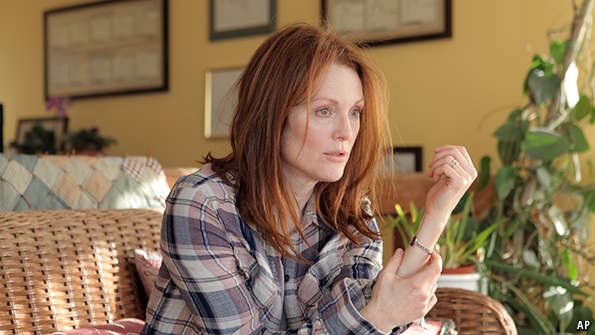


Still Alice is a compelling drama about a celebrated Columbia University linguistics professor who is suffering from Early-Onset Alzheimer’s Disease. Julianne Moore, in a career best, portrays Dr. Alice Howland who suddenly has trouble remembering words at a UCLA lecture. Ironically, the once brilliant master of syntax and semantics is forced to secretly record everyday words on a chalkboard in her upscale kitchen, test herself daily on her smartphone, and play “Words with Friends” to maintain her mental agility.
Based on the best-selling novel written by American Neuroscientist, Lisa Genova, the heavily nuanced screenplay is co-directed by Wash Westmoreland and Richard Glazer with input from Genova. The duo chronicle the frighteningly rapid decline of a brilliant mind that leaves you putting your own powers of recall to the test. When Alice, a physically fit 50 year old becomes disoriented on her regular jogging route on the Upper West Side, a visit to specialist Dr. Benjamin (Stephen Kunken), propels him to order an MRI, bloodwork and then a cat scan which reveals the grim diagnosis. Soon Alice forgets names and faces, is forced to google recipes and eventually must tell her husband and three grown children Anna, Lydia and Tom. It is alarming to learn there is a 50% chance that this rare disease could be passed on to children.
When she is more or less still Alice, the frustrated intellect cries: “It feels like my brain is fucking dying and everything I have worked for my entire life is going to shit.”
Supporting cast members include a likable Kristen Stewart as Lydia, the struggling actress in LA, who surprisingly, finds strength over time to cope with her mother’s cognitive deterioration. Kate Bosworth plays Anna, her prickly big sister, a married lawyer who is trying to start a family through in-vitro. While Bosworth delivers a solid enough performance, she is annoying so we are not that sympathetic when we learn she has inherited the gene for this ill-fated affliction. Hunter Parrish of Weeds plays a smaller role as brother Tom, a pre-med student with a pretty girlfriend.
Alec Baldwin is rather arrogant and not very believable as Dr. John Howland, a seemingly devoted husband and father. Maybe it’s because he was so convincing as the jerky husband in Blue Jasmine, but throughout this film his spurious concern for Alice can be evidenced in his planning to uproot his ailing wife so he can accept a prominent position at the Mayo Clinic in Minnesota.
Neurologist Dr. Benjamin, is the most comforting and supportive. The cinematographer (Dennis Lenoir) did many intense close-ups between doctor and patient, a technique that heightened the impact of their serious conversations. When Alice gives a talk at an Alzheimer’s Association event, Dr. Benjamin can be seen in the audience. It is here that our brave protagonist gets a much deserved platform to describe her life as she copes with a disease that slowly and cruelly plans to strip her of her identity. Wealth, privilege and intellect are meaningless as Alice grasps onto the person she once was, even stating that she wished she had cancer instead.
In a heart-wrenching scene, Alice whose face has grown more distant, suffers the indignity of wetting herself when she can’t find the bathroom in her Hamptons summer home. The filmmakers had hitherto managed to preserve Alice’s dignity, making the departure in the film’s third act really touch home. In another scene stealer, Alice discovers a suicide game plan in one of her computer folders, one that she’d composed before her illness manifested, the instructions being to swallow a bottle of pills.
Overall, Moore does the heavy lifting for the film and owns it just like Dame Judi Dench did in Iris. The five-time Oscar nominee could very well find herself at the podium accepting the award for Best Actress in a Leading Role.