
Superman Returns
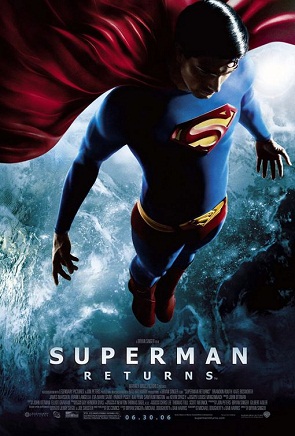


During the buildup to war back in 2003, many Hollywood observers (cynically) predicted that the onset of the war would lead to upswing in serious film. Some even predicted that coming hardships in addition to the current ones being endured before the military campaign would propel Hollywood to an age of filmmaking unseen since the 70’s. The effect in some manner of speaking has been the exact opposite.
Since the 2001 comic book superhero movies have positively exploded spawning a Spiderman franchise, two X-Men sequels, the re-launching of the Batman franchise and even lesser successes such as Daredevil. Most are based on ordinary citizens posted in New York City or some variation of who fight for justice but mostly because it keeps in line with their own personal motivations. Many of these films accentuate their protagonists’ explicitly human identities. Whether it be Peter Parker’s struggle to balance his power with social responsibility, or Bruce Wayne’s desire to accommodate justice with his own thirst for revenge.
Superman, however, is a different charge for numerous reasons. Not the least of which being how David Carradine so aptly put it in “Kill Bill Vol. 2”, he has to disguise himself as a human being. Superman’s real identity is his superhero persona, and his assumed identity is the one he must procure in order to live amongst the rest of the world. It is this mythos that distinguishes him from other superheroes. While others have taken power into their own hands, Superman had that power bestowed upon him and was sent from the heavens by his father (shown in flashbacks with old footage of Marlon Brando) to help the people of earth find their collective destiny. The others may be heroes but in terms of pop culture mythology Superman is the Messiah, he is, after all, the only superhero capable of answering prayers (so long as their spoken out loud).
Many Christ figures have risen and fallen in and out of pop cult consciousness (Neo, Frodo, and Buffy the Vampire Slayer to name a few) but Superman remains the most enduring. Superman also seems to be the most uniquely American as his mission during the 40’s and 50’s was to protect, “truth, justice and the American way.” (Something director Bryan Singer amends to here as, ‘truth, justice, and all that stuff’ something right wing bloggers have already become red in the face about.) Brandon Routh perfectly imitates Christopher Reeves’ ah shucks Midwestern Huckleberry Finn mannerisms, and his striking likeness to Christopher Reeves seems to go with the theme of the piece, which is reverence rather then revelation.
Singer seems content to rehash the Superman saga, in some cases lifting lines directly from the original, rather then to reinvent it. The opening title sequence is pure homage and Singer seems more at home studying Superman as an icon rather then as a character. While the original made its efforts to emphasis Superman’s humanity, Singer dedicates himself to his divinity.
He explicitly examines this through Superman’s relationship to Lois Lane (Kate Bosworth) who in his five year absence has won a Pulitzer Prize for an article entitled, “Why the World Doesn’t Need Superman.” She insists that the world doesn’t need a savior, that in a world without heroes, people are perfectly capable of looking after themselves.
With “Superman Returns,” it seems Mr. Singer begs to differ. While the world has not deteriorated in Superman’s absence (it seems Metropolis is more or less unchanged without him), it seems that Superman’s presence is required for more then to simply maintain the status quo. As he did with the “X-Men” films it seems Mr. Singer is trying to tap into what it is that makes these superheroes culturally relevant. In that vein he delivers us a comforting messenger to a world in need of a hero. While Mr. Singer may believe the world needs a savior, whether or not cinema does is another matter.
Despite Mr. Singer’s best efforts he can’t unshackle the idea that Superman is a hero whose time has passed. Superman is a character free of moral complexities, his idea of right and wrong framed in a pre 9/11 notion of black and white. Superman, unlike his DC and Marvel counterparts, is also beloved by his community and his special abilities make it next to impossible for him to lose almost any fight. While some may find the idea of invulnerability comforting, it’s a poor accessory for dramatic tension. His lack of psychological complexity makes him quaint in comparison to a Wolverine or even Spiderman. Superman doesn’t so much have desires as much as he serves as a vehicle for others desires. While Superman may have created a genre, his invulnerability to change, has allowed that genre to leave him far behind.