
The Departed
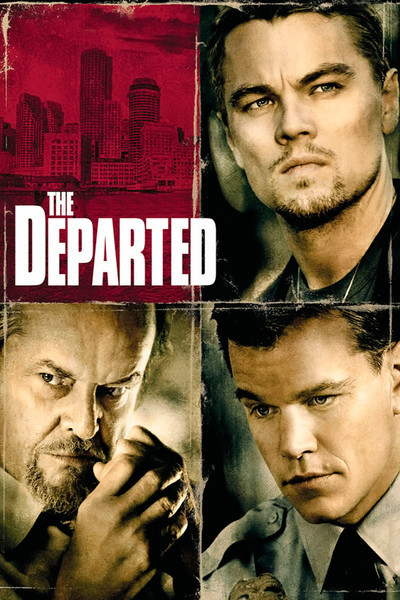


Given his recent penchant for classic Hollywood historical epics, it’s refreshing to see Martin Scorsese return to the crime milieu that he so successfully mined and expanded with films such as Mean Streets, Goodfellas, and Casino. With those films though, he showed us the world from the view of gangsters and hoods simultaneously depicting their blatant cruelty as well as their understated humanity. Scorsese’s men are not perfect and have no pretensions to be such, but they have their own sense of inner integrity that at least commands your respect if not admiration. With his latest offering, The Departed, Scorsese turns his camera to the other side of the coin and examines the world of crime from the perspective of law enforcement, good and bad cops alike. However, his insistence and examination of the flaws and virtues of his characters remains steadfast, if at times the course of the picture slightly wavers.
The film begins with recognizable Scorsese flair; Jack Nicholson comes on screen as Boston mob boss Frank Costello, draped in shadow, his voice illuminating the audience as to his philosophy and giving us our first insight into this malicious human being. He enters a corner grocery and notices a young boy, Colin, sitting at the counter. After insulting the store owner and his daughter, Costello buys a bag of groceries for the boy and instills in the young boy trust. Never has cinema shown a soul being bought for milk and bread before. The film cuts next to Colin as a young man, played by Matt Damon, training at the state police academy. Juxtaposed with his own situation, we are introduce to Billy, played by Leonardo DiCaprio; a Boston native from a shady family training for the police to break from his past. His past however eventually leads him to the attention of two Boston detectives, Martin Sheen and Mark Wahlberg, who wish to exploit Billy’s background to use him as a mole in Costello’s mob. What they are unaware of however is that Costello himself has a mole, none other than Colin himself who after carefully ingratiating himself into the system gains a command rank in the elite police unit trying to capture Costello. The two men eventually become aware of each other’s presence and have to hunt each other down, while maintaining their respective covers.
The plot will be painfully familiar to fans of the smash Hong Kong film, Infernal Affairs. Scorsese’s adaptation takes the original script and follows it beat for beat in certain instances, while still adjusting it enough to make it palatable for an American audience. While the original film delved into the concept of duality, the principle of opposites, Scorsese adjusts this by making the focus more on father-son relationships, akin to what he did with Leonardo DiCaprio and Daniel Day-Lewis in Gangs of New York. For Colin, Costello is a ruthless murderer but he has also been there to support him since he was a child and taken care of him, it is natural for some sort of paternal respect to kick, respect that Costello counted on all along and has easily exploited. For Billy, Martin Sheen’s character, Queenan, at first utilizes him for his ability to easily infiltrate the gang but as the pressure mounts on Billy, Queenan steps in and acts as a surrogate father to him, trying to ease his suffering when deep down he knows that may be impossible.
Nicholson, for his part as Costello, returns to form as a truly ravenous and repugnant villain. He is a man driven by an all-consuming id, nothing is ever enough and he has no problem using anyone at his disposal to serve his purpose and pleasure. Morality is meaningless to him as it is only another way to keep him from what he wants. Nicholson attacks the role with zeal and energy, it wouldn’t be too much of a stretch to say that Costello would be The Joker’s distant, possibly more stabile cousin, but not by much. Despite wavering as the performance continues and Costello appears to be losing his mind, perhaps mirroring Nicholson’s state of mind as well trying to keep this omnivorous monster going, the opening sequence in the shadows is a real tour de force. Nicholson exudes a sense of cool to the backbeat of The Rolling Stones’ “Gimme Shelter” that Tarantino would be incensed that he hadn’t filmed the sequence first.
In supporting roles, Alec Baldwin and Mark Wahlberg also turn in solid, support leads. Baldwin plays a police captain who’s in charge of the elite police unit out to get Costello, he brings his characteristic intensity to the role while also providing great comic dialogue, getting laughs as a straight man without having to have a wacky sidekick at his side. Wahlberg is the real prize though, not only does his own Boston upbringing ground his credibility as a Boston cop but he steals every scene he is in. He is a man dedicated to his job and unwilling to compromise on the smallest detail as he knows doing so will get his men killed. His is loyal to only himself and those he trusts and those are few and far between.
Another support worthy of praise is Vera Farmiga, who should be mentioned as she is the only female with a sizable part in the entire film. Cast as a police psychiatrist caught up in a love triangle between Colin and Billy, she pulls the most out of every scene she is given. While the setup of the triangle itself is a bit too strangely coincidental to be believable, she nonetheless shows us a woman trying to maintain stability in her life and is the first to admit that sometimes the best thing to do is lie. Like Sharon Stone in Casino, Vera shows up to the boys’ table and more than ably plays her hand amongst the competition.
In the end, there is the master behind the scenes of it all. Scorsese allows his voice to come through as equally strong as his actors through his camera technique and pacing. Few directors in cinema today can match his consistent ability to combine virtuoso camera movement and cutting with a solid sense of storytelling and ability to bring out strong acting performances. The comparisons to Goodfellas will no doubt begin and in a sense that is unfair. This film is not Goodfellas, as good as the performances in The Departed are, they cannot match the sheer depth of character and malice in that film’s gangsters. However, Scorsese has quite easily shown that if The Departed is not the next Goodfellas, it is still a fantastic thriller with shocks and surprises that simply work and that in and of itself isn’t too bad. While The Departed may be relegated to B-level Scorsese in comparison with his unmitigated masterpieces, his B-work is still head and shoulders above most of Hollywood’s A-work. That cannot be disputed.