
The Proposition
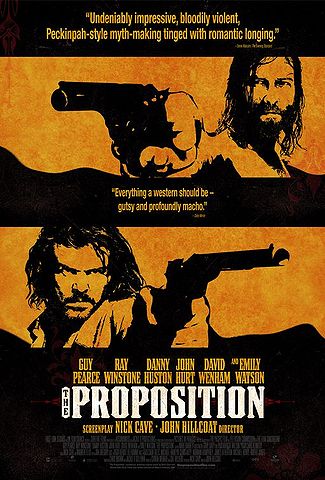


Set in an unfamiliar expanse, written by a legendary cult musician better known for his Leonard Cohen-esque vocals and moody, gothic lyrics, and evoking a mood and spirit familiar yet alien to audiences, The Proposition, written by Nick Cave and directed by John Hillcoat does what the westerns of Sam Peckinpah and Sergio Leone did in times past, take perhaps our most traditional and ‘American’ of film genres and turned it on its head to explore issues previously unexplored.
The plot (term being used loosely) begins when Captain Stanley (played by Ray Winstone) surrounds and captures two members of the infamous Burns gang, Charlie (laconically portrayed by Guy Pierce) and his younger brother, Mike (Richard Wilson). Upon capture, Stanley offers his proposition to Charlie – if he agrees to hunt down and kill his older brother, Arthur (Danny Huston), then Stanley will agree to let both Charlie and Mike go free. Arthur and his gang are responsible for the slaughter of the Hopkins family in the town that Stanley defends, along with other heinous deeds. Charlie has nine days to complete this task. Ironically, the end of the time table coincides with Christmas. If Charlie can kill Arthur by the end of that time, then he and his brother are free, if not, they will hang. From that point forward, the film follows a dual track, on the one hand, the viewer follows Charlie as he journeys across the Australian outback, seeking out his older, seemingly merciless brother and their tense reunion (including running into an eccentric bounty hunter played in a scene-stealing performance by John Hurt), and on the other, we view the lives of Captain Stanley and his wife, Martha (Emily Watson) as they attempt to hold onto their values and struggle in the unforgiving Australian outback and the pressures they face.
After the initial charge of Stanley laying out his deal and Charlie venturing forth to fulfill it, the film takes on a meandering yet hypnotizing pace. With Charlie, we watch him ride across the desolate, bleached desert landscape that is unlike Ford’s Monument Valley but more akin to Leone’s Almeria backdrops for his classic films. Throughout the film, one never loses the visceral evocation of this land’s harshness. All the characters, with the exception of Martha, are covered in dirt and sweat suggesting not an aversion to bathing but suggesting to the audience that no matter what you do, the desert will impose itself on you.
It is this choice to evoke both the scorched beauty of the outback along with the filth and sweat of the inhabitants within that is effectively shot by cinematographer Benoit Delhomme. The grit and grime of the characters brings back memories of Leone’s filthy yet compelling outlaws and townfolk. Not content to be simply a screenwriter, Cave also composes the film’s score with alternating quiet passages of him speaking along with harsh, scratching noise that combines traditional Aboriginal music with Morricone dissonance.
One of the unstated themes of the film is the relationship between man and nature. More specifically, the choice to accept and learn to live in harmony with one’s surroundings or attempt to adapt and bend those surroundings to one’s will. It is in this arena that Hillcoat and Cave present the viewer with two characters symbolizing both extremes of this dialectic tension. On one side, lies Arthur Burns, who played by Huston, comes across as a sort of Australian Kurtz, living in his own heart of darkness, yet unlike that character has seemingly reached a degree of inner peace and calm. There are endless shots of his sitting cross-legged, staring out over the horizon marveling at how truly wondrous and vast this land is. Arthur knows it’s a hard land, yet by accepting it and giving himself over to it, he is ultimately at ease with it despite the hardships it brings. Stanley, however, along with slimy government official Eden Fletcher (David Wenham) can think of nothing more than tempering this desolate country to suit their own narrow needs and desires. They are in a constant war of making their traditional English values and ideals relevant in a place that can easily crush those values with its unrelenting heat and desolateness. While Arthur can move among this landscape with ease, Stanley and those he represents are imprisoned by it, clinging to the makeshift bastions of civilization that keep them from being swallowed up.
Another implicit but equally relevant theme that the film also addresses is the historical treatment of Aboriginals by the English colonials. While this is a theme that has been tackled in Australian film before, notably in The Chant of Jimmie Blacksmith directed by Fred Schepsi, it is a topic that has never been fully addressed to American audiences. The Aboriginals figure into the story as the human symbols of this land and especially in terms of how the colonials treat them according to their own values. The Aboriginals, as treated by Stanley and the government forces he represents, are savages to either be pacified or obliterated. At one point, Fletcher talks to Stanley about the death of a trooper as retaliation for some of their own people being slaughtered. Fletcher clarifies for Stanley that if he is to kill one Aboriginal, he better makes sure to kill them all to avoid another trooper’s loss. Juxtapose this to Arthur’s gang, where his right-hand man ostensibly is an Aboriginal who is more than willing to kill not only white troops but Aboriginals who collaborate with them as well.
While the film is rife with visual grandeur and engaging subtext, the main thing that keeps this film from rising from simply a good Western to a great one is its very looseness of plot. While the simultaneous plotlines pull the viewer along, the film feels like it negates the sense of urgency that is created by Stanley’s proposition. Rather than creating a tighter pace which would underscore the seriousness and race against time that Charlie faces, the film loses this pacing as it devotes time to other scenes and subplots that while interesting to view, do not add as much to the overall plot and would more than likely allow the film to play better if cut. Despite this issue however, the performances, setting, and story more than compensate.
In the end, we are left with a new, worthy addition to the Western genre. Both the actors and filmmakers have crafted a film that while staying true to many of the conventions of this most American of genres, have also brought a flavor and cultural imprint that is uniquely Australian by tackling issues and themes that are unique to that region, spells out similarities to our own culture and history that should not be ignored.