
The Science of Sleep
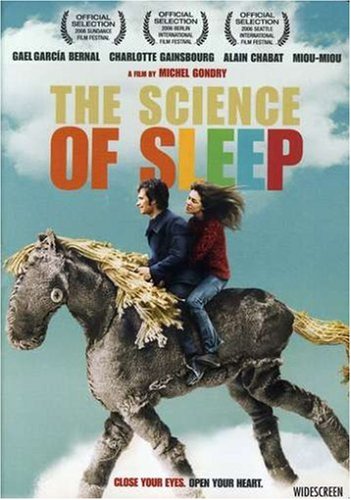


Whether it’s fair or not Michael Gondry’s latest creation, “The Science of Sleep,” will be judged on the bar set by his previous romantic surrealist flight of fancy, “Eternal Sunshine of the Spotless Mind.” While to be far, “The Science of Sleep,” is extroadinarily inventive and eye poppingly energetic in comparison, the film goes down like day old champagne. It still has enough bubble and fizz to hold your interest, but in the end accomplishes nothing more then being pleasantly unsatisfying.
“The Science of Sleep,” centers on Stephane, an illustrator returning to Paris to take up a job his mother has set him up with. Stephane is under the impression, that the job (one involving calendars) is creative in nature, but when it turns out to be merely a cut, paste, and copy position Stephane finds himself having to accept another one of life’s stinging disappointments.
Stephane, it seems, has the sensitivity of a sponge. Something that drives the child like quality of his constant dreaming (many of which are brought to cinematic life using old school special effects like stop motion animation and paper mache), but also has the unfortunate effect of crushing any ability to live outside the sphere of his own hyperactive romanticism.
Stephane then meets Stephanie (Charlotte Gainsbourg), a neighbor who moves in across the hall. Stephane is introduced to her when he attempts to help move a piano into her apartment, but relents under the weight, as it crushes his hand before escaping and barreling down the stairs.
The two begin an awkward courtship. Stephane, however, though thrilled by the prospect of romance, is terrified at the prospect of rejection. In his charming stop animation dreams Stephane and Stephanie are able to scale such great heights, but reality usually proves far too uncooperative. Stephane dips his toe into reality the way some children may a cold swimming pool. All too often he recoils, escaping into his own mind, where he’s free from the unseemly swings of an indifferent Universe.
Gael Garcia Bernal plays Stephane like a man truly handicapped by his own romantic aloofness. Stephane approaches his job, like he’s never held one before, and approaches Stephanie like he’s never before dealt with infatuation. After a while it becomes clear that Stephane up till now has shielded his virgin eyes from such potential unpleasantness.
This also becomes clear in his dreams, as they slowly devolve from celebrations of self hood and independence into the shadowy cries of a neglected subconscious, isolated and crying out to A reality the barer is still not fully prepared for.
Charlotte Gainsbourg plays a worthy romantic foil to Bernal’s man-child. Her attraction to Stephane speaks of her own character’s enduring sense of romantic idealism, but her refusal to get attached shows she understands that she needs Stephane to inhabit a world she knows he’s still not fully prepared for. She carries her character with the kind of emotional undertow that suggests that she’s just turned the corner from a past disappointment. In a sense, it’s this undertow that makes her variety of optimism braver then Stephane’s. She has made the most of a world in which he still refuses to take part in.
“The Science of Sleep,” seems to have a similar mission statement as that of “Eternal Sunshine of the Spotless Mind,” which was to display the ups and downs of a contemporary romance with equal parts surrealist intensity. However, without the writing talents of Charlie Kauffman nor the caliber performances of Kate Winslet and Jim Carrey, “The Science of Sleep,” mostly falters under the weight of it’s own inflated sense of ambition. While “The Science of Sleep,” is definitely superior to many of the films that have come out this fall, it set’s it’s own bar and it’s own expectations quite a bit higher. It seems appropriate then it’s own self made universe, “The Science of Sleep,” cannot bear the brunt of it’s own ambition.