
Trust The Man


Bart Freundlich has spent most of his career exploring familial minimalist angst. His first film “The Myth of Fingerprints,” studies an over anxietied passive aggressive Maine family on a Thanksgiving holiday. His second feature the more flawed “World Traveler,” was at least anchored by a sublime performance from Billy Crudup as Freundlich attempted to muse about the selfish self destructiveness of a middle class Manhattan dad. The set up for his third feature film, “Trust the Man,” appears the same on paper, although Mr. Freundlich has never previously approached familial angst, with this little gusto.
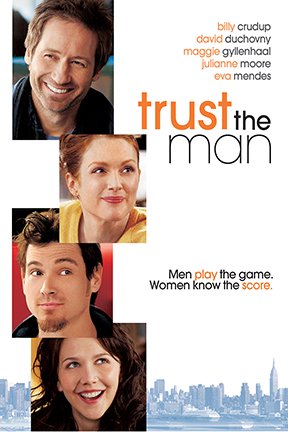
The film focuses on two sets of couples. One the idyllic marrieds, Tom and Rebecca (played by Mr. Freundlich’s real life wife, Julianne Moore and David Duchovny) and the glamorous singletons Tobe and Elaine (played by Billy Crudup and Maggie Gyllenhaal) both couples are essentially the same except one seems to shower less.
Tom and Rebecca begin the film talking to a marriage councilor. The basic problem comes down to the fact that he likes sex and she’s lukewarm about it. Tom plays stand in therapist for his best friend Tobe. Tobe laments that Elaine wants to get married and have kids, while he’s lukewarm about it. The scenes with Crudup and Duchovny give the film its few points of dramatic momentum. At its core “Trust the Man,” wants to be a film about selfish middle-aged manly existential crisis and when Duchovny and Crudup share the screen it succeeds. Mr. Crudup with his pompadour and ridiculous goatee gives Tobe an offbeat charm that’s not on the page, often giving an earthiness and sincerity to the most contrived of utterances (credit must be given when an actor can still make, “did you ever think your life would turn out differently,” new shades of authenticity) . Mr. Duchovny, a true actor’s actor, in their scenes together complements him perfectly. The scenes with Ms. Moore and Ms. Gyllenhall, however, often seem less authentic and often just seem a rehashing of what might be found on a Julia Roberts romantic comedy cutting room floor.
Mr. Freundlich, however, doesn’t have the wisdom to see that his screenplay is mostly, just a lot of weak tea. The conflicts of the film are often short changed as it seems Mr. Freundlich is frightened that too much drama will get in the way of everyone’s buzz. An attitude, which serves as a detriment as Mr. Freundlich has severely overestimated his own comedic aptitude.
“Trust the Man,” in its presentation appears to be the kind of middle of the road adult romantic comedy studios used to trust mainstream audiences with. The kind of comedy that finds children and poo equal parts hilarious, and whose idea of a comedic homerun is a Heimlich scene played out to the musical overture of Marvin Gaye’s “Let’s Get It On.” Mr. Freundlich seems to be trying to give us a throw back to the kind of New York set romantic comedies of Woody Allen and “When Harry Met Sally,” where love and possibility is interlaced with equal parts neurotic sex talk.
It seems that the studio may have did Mr. Freundlich a tremendous disservice by giving the most hardened movie audiences of New York and L. A. first crack at his latest creation. Especially since indie movie going types are the very kind of people that “Trust the Man,” pokes caricatured, peripheral, amateur fun at. The real reason, however, that “Trust the Man,” won’t play big with those audiences is because it’s the type of Hollywood creation that mistakes basic common sense with revelation. “Trust the Man,” wants to insert itself in the canon of New York romantic comedies, but doesn’t have the sense to trust it’s own titles sakes, and realize this film rightfully belongs to Mr. Crudup and Mr. Duchovny.