
American Gangster
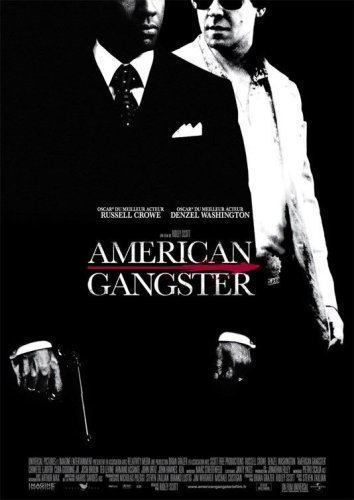


Operating along two parallel plot threads, the film splits its time between Harlem heroin kingpin Frank Lucas (Denzel Washington) and police detective Ritchie Roberts (Russell Crowe). On paper and indeed on screen, the match-up makes sense and works quite well. Effectively male co-leads, both actors anchor their respective storylines as they converge towards an inevitably collision. The story kicks off squarely in Lucas’ court though; a terrified man is tied up in a chair and doused in gasoline. The camera pulls back and we see Lucas along with his boss and mentor, legendary Harlem gangster Bumpy Johnson (Clarence Williams III). Lucas ignites a lighter and promptly tosses it on the victim’s body, setting him ablaze before brandishing a pistol and finishing him off coldly. The very next cut shows Bumpy on the back of a truck tossing out free Christmas turkeys to a cheering crowd with Frank standing in the background watching.
With these two brief sequences, Scott and company attempt to immediate establish the dual morality of these types of men; willing to kill at a moment’s notice while still containing enough compassion to treat the community they are exploiting. After a brief lamentation about the travesties of whole sale selling, Bumpy dies and the king of Harlem is no more. A power vacuum forms and Frank is keen to fill it as quickly as possible. We then cut to Ritchie and his junkie partner as they discover a million dollars in unmarked cash through an informant; rather than taking the money as his fellow officers would gladly do, Ritchie instead turns it in and becomes a pariah in the department for doing the right thing. Serpico-like in his profession, we nonetheless discover that Ritchie’s home life is a disaster, facing an ugly child custody suit and having sex with every available woman around him.
The plot seeks to constantly point out the dual, paradoxical natures of these two men; one is involved in breaking the law yet maintains his own strong sense of ethics and discipline, the other upholds the law fearlessly yet is emotionally immature and bereft of emotional responsibility. The constant drumming of this particular beat becomes irritating after a while, yet Crowe and Washington are dynamic enough screen presences that you forgive the story’s overemphasis. To build his own empire, Frank hooks up with a military-connected relative to directly purchase pure heroin from Chinese heroin lords in Thailand itself. Facing the problem of transportation, Frank colludes with military officials to smuggle the drugs in using transport coffins holding dead U.S. soldiers. A macabre but ultimately brilliant means of slipping in the shipments undetected.
Bypassing the traditional Mafia heroin suppliers and their fees, Lucas is able to bring in higher quality drugs for incredibly cheap prices. He is able to provide addicts with a product that is double the quality of everything else on the streets for half the price; so while Bumpy disdained whole sale business, Frank seized upon it and began amassing a fortune with it. He quickly puts his competition in place including famous rival dealer Nicky Barnes (played in a brief and unfortunately broad performance by Cuba Gooding Jr. as well as the subject of Marc Levin’s documentary Mr. Untouchable) and even brings his younger brothers up from North Carolina to oversee the operation with him. Always intriguing actor Chiwetel Ejiofor plays his second-in-command Huey, constantly struggling between personal flash and modesty Huey means well but all too often displays his naïve, country roots. Hip hop artists Common and TI also play relatives of Frank who are sucked into the business.
Meanwhile, Ritchie is assigned to a newly-formed, federal, narcotics task force determined to bring down this mysterious, new supplier in Harlem all the while steering clear of police corruption openly on the take. At the peak of success, Frank makes one small mistake which allows Ritchie to finally key into his operation and from there the rest of the film follows how the house of cards finally tumbled down. Ridley Scott is a director who, among other things, is well-known for rendering complete, detailed worlds within his films. His training as a production designer is always evident as he always wants to show the viewer the big picture and genuinely transport you into a fully-realized environment. American Gangster is no exception to this pattern, whether shooting in Bangkok and the jungle to evoke late 60’s Thailand or cobbling together existing locations in Harlem to evoke the urban decay and squalor that the city wallowed in during the 70’s. One can readily feel the influence of classic cop films like The French Connection, Serpico, and Prince of the City on American Gangster’s period look and feel.
Talented cinematographer Harris Savides lights the film in muted, gray tones in order to convey the grime of both the streets and characters while employing almost documentary-like camera movement and coverage ala The French Connection. The effort is admirable and overall effective; although you can almost sense the strain the filmmakers must have been under to find existing locations that still convey the grittiness of 1970’s New York after the widespread cleanup the city went under during the Giuliani administration. Scott and his collaborators probably would have had an easier time shooting this film if they had a time machine to go back in time fifteen or twenty years ago.
Performances though are what really drive this film and with a solid, ensemble cast led by Crowe and Washington it’s hard to find bad work here. Russell Crowe attacks Ritchie Roberts with commendable bravery, he doesn’t imbue the character with any overly macho preening; he lets it all hang out as he fumbles through his work and his personal life, trying to keep in touch with his son and appease his ex-wife (Carla Gugino) while fucking his lawyer, a stewardess, and any other beautiful woman he can. The performance is reminiscent of Paul Newman in The Verdict in that both men have everything going against them and can barely hold their lives together, but still have a force of will powerful enough to keep everything together just long enough to get the job done.
On the other side of the coin, Denzel strolls onto the screen with the confidence that both this role demands and that he has always had in abundance. As the central figure in the tale, Frank Lucas has to be an imposing man and Washington is able to pull off that confidence and poise without a problem. In addition, his natural charm and killer smile effectively come into play when showing off Frank’s own charm and seductiveness. The problem though is that while Denzel effortlessly shows us the power, he is often unsure of the ruthlessness needed to run such an empire. There are moments of brief, surprising violence yes, shooting a man in the head, crushing another’s skull with a piano, etc. We see that the character is prone to indulging his murderous rage but what we don’t see is the cold ruthlessness needed to knowingly poison one’s own community for the sake of profit.
Instead, Washington and the plot consistently try and reinforce Frank’s family values and strong, work ethic thereby trying to say that brushing past the whole drug dealing thing, he’s really just a nice guy. In doing so however, they completely ignore what Frank Lucas was and why you are watching the movie in the first place, he’s a gangster plain and simple. He profits from selling drugs to his community which destroy the lives of addicts before killing them. So yes, while it is important to show that benevolent side of Frank’s personality when it came to his family, we really need to see the complete disregard for people in favor of money. Denzel needs to show the viewer that deep down he doesn’t give a shit about who buys his product as long as they show him the money and the ruthlessness that that mindset breeds is missing. Washington needed to dig deep and honestly portray the ugliness and ruthlessness that Frank Lucas had to maintain such a profitable business, to make us truly loathe him as well as like him. That’s exactly the sort of thing that Al Pacino did to make Michael Corleone in The Godfather a great character and performance, you hated him and loved him equally at the same time and that’s what Washington’s portrait unfortunately doesn’t pull off here though.
Surprisingly, the most menacing performance and truly compelling villain in the entire film is not another gangster but a corrupt detective played by Josh Brolin. As Detective Trupo, Brolin is emblematic of the corrupt Special Investigations Unit, a NYPD branch that worked independently and handled big-time cases while being incredibly corrupt and engaging in criminal activities as awful as the crooks they pursued. Early on, we see Trupo and his men seize French Connection heroin only to cut it and sell it themselves back to the mob. Slick and cold, Brolin operates with impunity as he shakes down Lucas at every turn and shows the wannabe gangster how a true thug operates.
Director Scott is smart enough though to show fast montages of addicts scoring Lucas’ Blue Magic heroin and shooting up in sore-infested veins, strung out and overdosing. However, these sequences are still missteps by falling into the classic paradox of pointing one’s finger at crime while glamorizing it in the very same frame. Classic funk songs blast through with Superfly swagger as dealers deal and junkies shoot up so the claws of criticism are immediately filed down by the cool beats and attitude they represent. In the end, these minor missteps hold the film back from the elite fraternity it wants to be apart of and at nearly three hours with only one memorable action sequence at the end, it tries the viewer’s patience while still being entertaining and engaging. An solidly, executed crime thriller that no doubt will be an Oscar contender and probably deservedly so.