
Before the Devil Knows You’re Dead
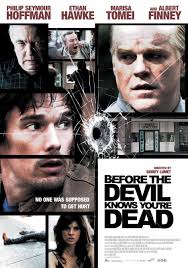


| Review by IFQ Critic Todd KonradAt age 83, Sidney Lumet has crafted his best film not only of the past ten years but his entire career with Before The Devil Knows You’re Dead. After the disastrous reception for his 2002 Vin Diesel vehicle, Find Me Guilty, it would have been declare Lumet’s fifty year career at an end. Five years later though, he shocks the film establishment and audience with a movie that displays a command of material and technique that is energetic yet tempered by well-earned experience. Released by THINKFilm, Before The Devil Knows You’re Dead easily joins the ranks of Lumet classics like Serpico, Prince and the City, Long Day’s Journey Into Night, Dog Day Afternoon, etc. and for good reason. Like those oft-celebrated films, Lumet brings to bear his deceptively invisible technique upon a solid, crafted screenplay (here written by scribe Kelly Masterson) and a phenomenal cast including Philip Seymour Hoffman, Ethan Hawke, Albert Finney, and Marisa Tomei among others who each turn in performances worthy of award consideration.
Seemingly taking a play out of the Tarantino generation’s playbook for non-linear structure, the plot begins unfolding on an innocuous Saturday morning at a nondescript Westchester strip mall which houses among other chain outlets a small jewelry store. An elderly woman, one of the store’s owners, is preparing for the day’s business when a masked thug breaks in and immediately holds her up for the store’s jewels and loose cash. What begins as a routine stick-up quickly turns violent as shots ring out and blood is spilled. From that point forward, Lumet eschews traditional, linear storytelling and instead flashes back days before the robbery introducing the audience to the perpetrators of this crime. Andy Hanson (Philip Seymour Hoffman) is a relatively successful, New York real estate broker who finds himself financially overextended while running a small, embezzlement scam out of his office. He’s married to beautiful wife Gloria (Marisa Tomei) and lives in a stylish, Manhattan apartment. Seeming to enjoy a comfortable life, Andy instead feels trapped by the financial and social constraints his life operates within and is looking for a way to break out and start a new life. Needing money fast, he strikes upon a perfect little scheme but needs help pulling it off. Enter Hank Hanson (Ethan Hawke), Andy’s younger brother who’s constantly broke between paying his daughter’s child support as well as other accrued debts. Like Andy, Hank is saddled by a life seemingly out of control and pressing him down. Suddenly though his big brother lets him in on what appears to be ‘the perfect crime’. At stake is a simple robbery, a mom and pop jewelry store with little security and plenty of loot to fence. When all’s said and done there should be enough money for both brothers to start over and put their problems behind. The only catch is, the mom and pop in question are Hank and Andy’s own parents Charles (Albert Finney) and Nanette (Rosemary Harris). Initially bothered by robbing the family’s store, Hank expresses understandable doubt despite forceful reassurance by big brother Andy. However, as the perfect robbery quickly disintegrates into a bloody tragedy, events quickly spiral out of control for Hank and Andy as they try covering their tracks, dealing with personal loss, and are unknowingly pursued for vengeance by others. Playwright and first-time screenwriter Kelly Masterson has worked out a screenplay that utilizes a non-linear, Pulp Fiction-like structure as a means to investigate character rather than as a showy plot device. Using the robbery itself as a fulcrum, the plot pivots backward and forward in time investigating each character’s individual perspective and motivations. Thus an entertaining, surface-level crime drama is actually hiding an incisive psychological map of character studies, each of which interact with one another in effectively melodramatic ways. As the lead up to the robbery is dissected via each character’s role, a darker portrait emerges of a family whose dysfunctions unexpectedly provide the moral root of this crime. Like the Tyrone family in Eugene O’Neill’s Long Days Journey Into Night, the Hanson family suffers from sins of the father. In a particularly, poignant exchange, Andy and Charles discuss their past together; Charles muses over recognizing his emotional failings as a father were only meant to prepare his oldest child for real life. Andy, meanwhile, reflects on his own social estrangement within the family unveiling jealousy and deep-seated neediness which soon gives way to dismissal. What begins as a somewhat hopeful exchange quickly gives way to recrimination and anger at the drop of a dime. The sharp emotional turn is believable and all the more painful as executed by two actors perfectly in sync with one another. The Hanson family moves from the realm of realistic drama and becomes an entity out of Greek tragedy. Their issues of jealousy, self-loathing, and anger ensure heightened dramatic energy which only fuels their spiral down the drain. At its heart, Before The Devil… is driven by a slew of brilliant performances; Hoffman continues his winning streak with Andy. Hoffman’s well-managed veneer courtesy of slicked back hair and sharp suits only hides a brittle mass of self-revulsion and failure. Always forced to think of a solution, Andy’s desperate desires foster a cold, ruthlessness that Hoffman perfectly projects beneath a pasty grin. With Andy, Hoffman fashions a man whom the audience is repulsed by yet sympathetic with which only provides discomfort of the proper sort. Not to be outdone, Hawke’s turn as Hank is brutally open and raw as a man who has never left adolescence behind him. Immature and emotionally fragile, Hank certainly has ‘self-esteem’ issues; his incessant neediness forces him to let down everyone around much to his family’s chagrin. He is practically masochistic in the amount of abuse he not only endures but practically welcomes with his demeanor. Special mention should be given to Marisa Tomei as Gloria who turns in one of her best performances in years. A trophy wife who perceives herself as valueless, Gloria is a woman plagued with low self-esteem and worth. The only arena she believes she holds coin in is her sexuality which Tomei perfectly exudes with her naughty smile and firm body. Gloria can’t cook, work, or do anything important but she knows she’s physically attractive and what men want from her. Even if it’s only sex, she can at least deliver and certainly does. Holding court as senior actor and previous Lumet performer (in Murder on The Orient Express), Albert Finney does right by his old collaborator as Charles. Stricken by enormous grief over what transpired, Charles turns his grief and anger inward and vents it the only way he knows how: vengeance. As the camera closes in upon his face, Finney achingly exudes genuine heartache and loss within those deep crags. Yet those same churning emotions are unable to find healthy relief so instead they only provide energy to lash out at those around him and get to the bottom of this crime. Last yet certainly not least in this team is Lumet himself. Crafting a precise yet visually stunning world with the aid of production designer Christopher Nowak, Lumet once again shoots in his beloved New York conveying the sleek elegance of Manhattan as well as Brooklyn grit. With DP Ron Fortunato, he throws in a solid mix of static long shots, smooth tracking shot, and handheld, camerawork in a rather seamless, invisible manner. Never one to be consciously showy, Lumet’s visual technique is not often celebrated for sophistication; however with a bit of attention he brings to the fore a simple yet confident command of visuals. He’s not showy because he doesn’t need to be, he knows that by adopting an invisibly approach the emphasis stays on the story and performance which ultimately is what elicits emotion from an audience. Lumet’s greatest work comes from simply having a solid script and a group of actors secure in their craft and willing to be pushed to their limits. Before The Devil Knows You’re Dead perfectly fits that mold and without reservation is one of the best films of the year. |