
Blue is the Warmest Color
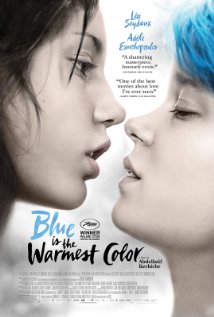


This movie is real. Beautifully real. Disturbingly real. Shockingly real. Tragically real. Hopefully real. Utterly real. “Blue is the Warmest Color” is what happens when a director and actors rip open their very souls and pour them out for the world to consume. It is life’s most simple glories, failures, sorrows, and joys, fears and successes, set before us as art, demanding to be seen, accepting of our responses. The film is sixty seconds shy of three hours long, yet viewers will find themselves wishing it would never end.
Director and co-writer Abdellatif Kechiche is a master at capturing life’s most precious moments. Starting with the story’s sun, Adéle, (Adéle Exarchopoulos), we see a painfully, naturally beautiful woman-child (on the verge of high school graduation) at her best, and her worst. Expect no typical images of a main actress sleeping with perfectly folded sheets, hair smoothly falling in shiny cascades down a pressed pillow, though. Instead, Kechiche exposes Adéle’s slumber in a more truthful display; mushed, half open, Cupid’s bow lips, wavy, tussled tresses strewn across her cherubic face, flat on her stomach with one knee up and arms askew. When she cries, her nose runs, her skin pinks up, and her mascara trails in tears down her otherwise makeup-free visage. When she eats, she devours her food, making no falsely modest dabs at the corners of her mouth. She wears the drippings of spaghetti sauce like a badge of honor. Even so, her mouth begs to be kissed…seemingly by everyone with whom she comes into contact. It is one of the most believable responses in a movie filled with believability. The authenticity is both inspiring and captivating.
Perhaps it is the confidence of the culture, (the movie is entirely in French, with subtitles), but the characters are passionate and unapologetic in their charms and failings. Léa Seydoux (Emma) can scream eardrum-bursting emotion with a mere, almost imperceptible curve of her mouth, cocking of her head, or tilt in her eyebrows. She is the penultimate Yin to Adéle’s Yang, and orbits her as the closest of the planetary personalities in Adéle’s solar system. Emma is the most likely to wash in her warmth, and the most at risk for getting burned.
The sex scenes earned the movie its NC-17 rating (although you can see it on Netflix), but the intimacy is far from gratuitous. It is not only imperative to the story, it is refreshing to see it presented with such regard. It is fairly graphic, by American standards, but artistic, passionate, and blatantly genuine. Real.
I found myself repeatedly asking myself if “Blue is the Warmest Color” was a documentary, or simply cast with the best actors the world has ever seen. Truly! Sure, I like lots of actors, some of whom I think are grossly underrated or deserving of higher accolade. This movie, however, was different. Not once – not once – did I feel I was watching something scripted, contrived, or acted on screen. The raw realism in “Blue is the Warmest Color” brought legitimacy to the movie as I have never before experienced. The range of settings, emotions, and situations was considerable, but each actor in every scene was their character. I can honestly say I never felt more invested in a movie’s players, which is probably why its creators got away with almost two-hundred minutes of film. Even the most mundane moments in the movie were charming, endearing. This movie is touching, provocative, humorous, heart-wrenching, and optimistic. It is “must-see” for anyone (over the age of seventeen) who missed it in theaters.