
Romance and Cigarettes


As movie-growing audiences have grown increasingly sophisticated over the decades, it’s hard not to notice an unforeseen abandonment of the once-respected ideal “suspension of disbelief”. To clarify, this does not mean believing that the gargantuan robots spreading mayhem or flying kung-fu antics are meant to be seen as concrete and sacrosanct. No, the change has come in audiences demanding that every shot, character action, even editing choice has to make sense and convince them without fail that it is logical and “believable” akin to actually being possible in our real world in some fashion. In short, visual literacy has led to a sort of backlash where audiences no longer really allow themselves to put all their knowledge aside and just accept films depict wholeheartedly and without judgment.
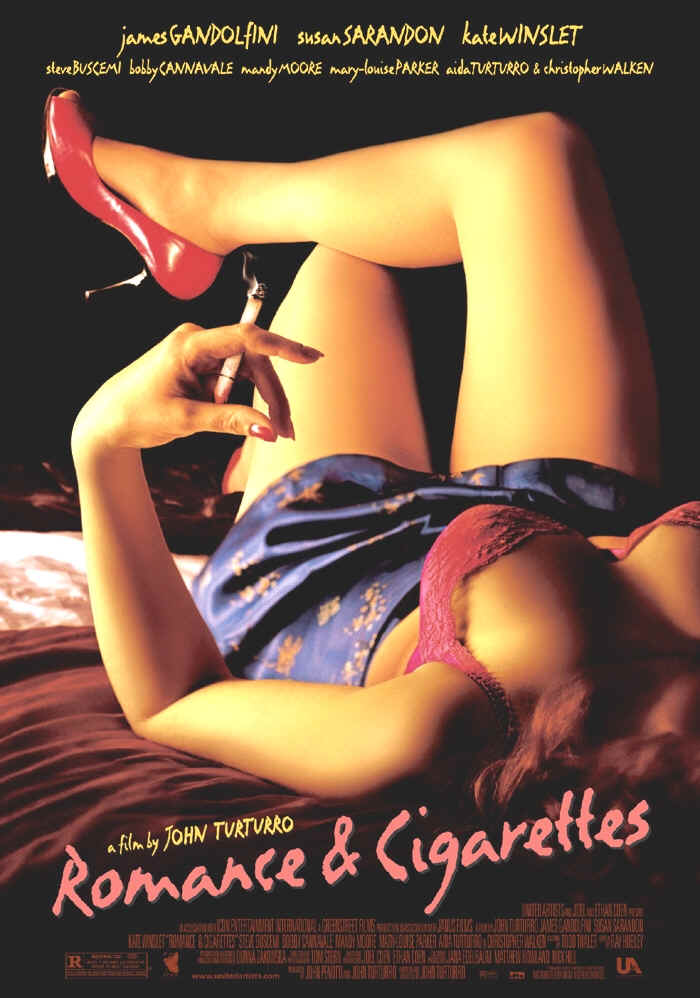
An obvious and sad victim of this sea change has been the once-stalwart Hollywood musical. Whereas in the past, characters unexpectedly breaking into song was simply accepted and enjoyed by audiences, now such fare has to go to backbreaking lengths to justify such deeds and in being forced to work so hard, musicals have lost a touch of the light, sublime charm that makes classics like Singin in the Rain still endure. Respected actor and director John Turturro revives the mood and feel of classic musical drama while adapting it to the modern world in his odd yet charming film Romance & Cigarettes. The film which stars James Gandolfini, Susan Sarandon, Kate Winslet, Christopher Walken and a cavalcade of other well-known talents is crafts a lyrical yet dark musical out of an all too real, blue collar existence.
Gandolfini stars as Nick Murder, a New York construction worker who seemingly enjoys a typical blue-collar, suburban existence with his family out on Long Island. Married to long-time sweetheart Kitty (Sarandon), a seamstress who is tough yet kind and three daughters played by Mandy Moore, Mary-Louise Parker, and Aida Turturro, Nick is hiding a secret from them that Kitty unexpectedly discovers at the film’s onset. Confronting Nick with a piece of erotic poetry, Kitty calls Nick out on his affair with another woman, the blistering redhead Tula (Kate Winslet). A shouting match ensues and soon after, kicked out of his house, Nick’s emotions swell and he bursts into song with “Man Without Love”. Swept up into this maelstrom are the entire neighborhood’s male population, swooning and singing about how their lives are incomplete without a woman’s love. Its sheer unexpectedness is bracing yet the full-on commitment to fully expressing the emotions within the song and how they relate back to Nick’s own situation is in full alignment with a classic musical idiom “when the emotion’s too strong, sing it”.
For an audience unused to such conventions, the sequence is disturbing but it works perfectly if one is willing to simply sit back and accept the film for what it is and doesn’t question it. As Nick struggles with a choice between his hurt wife and his oversexed mistress, a web of various other subplots ensue. Kitty is hell-bent on revenge against Nick’s whore with the aid of Cousin Bo, an Elvis-obsessed relative played by a man perfectly trained to operate in a musical Christopher Walken. His swept up hair, huge sunglasses, and idiosyncratic dance moves not only pay bizarre tribute to the King but to his own past as a musical performer as well. Nick’s youngest daughter (played by an effective Mandy Moore) falls in love with the neighborhood lothario Fryberg (played by Bobby Cannavale) and so on. Anchoring much of the action is Gandolfini himself as his character is thrown from one vice grip of pressure into another while learning that his time on Earth may be coming to a near end. His affair with Tula is passionate and gleefully filthy but he has to contend with her desire for a genuine relationship with substance.
For her part, Winslet plays the role of vamp to the hilt. Sporting a rough, Irish accent and flaming, red hair, her Tula is a woman possessed; she craves sex but only as a means to find love. Her emotionally immaturity is sublimated into physical ferocity and as she finally begins to change herself, the audience knows that only heartbreak can ensue. Sarandon turns in yet another portrait of a strong woman fighting to maintain dignity while expressing her deepest feelings. We’ve seen it from her before but she still knows how to make it work. Taking chances left and right, Turturro fashions a visual world that is more in tune with European art cinema that modern American melodrama. Characters from one’s past (a la Kitty’s ex played by Tony Goldwyn in brief but satisfying asides) unexpectedly manifest themselves in the present without reason and return to the same ether from whence they came.
The consistent intrusions of fantasy into reality are more in line with movies like Fellini’s 8 ½ or more pointedly Luis Bunuel’s late, surrealist masterpieces, i.e. The Discreet Charm of the Bourgeoisie. For a more contemporary example to compare with, Romance & Cigarettes functions like a teleplay Dennis Potter would have written had he lived in America not England. Known for such ground-breaking musicals like The Singing Detective and Pennies From Heaven (two BBC miniseries that suffered unfortunately from well-intentioned yet unsuccessful Hollywood adaptations), Potter crafted dark, complicated dramas that used the conventions of musical theatre to underline the very sad, conflicting emotions that drove the conventional narratives forward.
Yet what those projects and Romance & Cigarettes touch upon is cinema’s very strong yet unspoken sense of surrealism. Cinema inherently doesn’t make sense if you think about it, lights flickering on a wall shouldn’t be able to make people cry, think, or angered but in this particular form it can. Its very unreality touches upon our own world profoundly and what better way to highlight that than to place seemingly normal people into situations where they drop everything and break into song? To be fair, there will be many who probably will not like this film but a large part of it will come from simply not accepting its pure, surreal nature. Yes there are things in it that probably won’t make sense and make you scratch your head but so what? With projects like this, to truly enjoy them you have to accept what they are and leave it at that. And if you do, what results is a story of love, loss, regret, and redemption played across the lives of fairly normal people whose emotions are so strong that the only way to release them is to move from the real into fantasy.
For more information, go to www.romanceandcigarettes.com.