
Rudo y Cursi
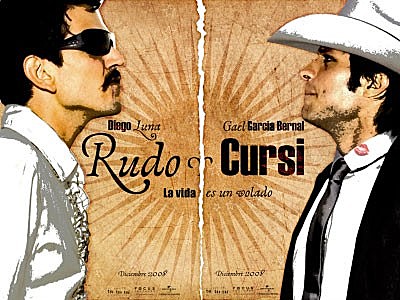


The first feature from the Mexican production company Cha Cha Cha, Rudo y Cursi, certainly has quite a legacy to live up to in terms of the pedigree it represents. Directed by Carlos Cuaron, brother of noted filmmaker Alfonso, and produced by the aforementioned Alfonso, Alejandro Gonzalez Inarritu, and Guillermo del Toro, you would expect there to be a bit of pressure on their first joint production under the banner of this new shingle. Thankfully, Cuaron (Carlos in this case) and his wonderful cast including the always watchable Gael Garcia Bernal and Diego Luna deliver in this dark, playful comedy, released Stateside courtesy of Sony Pictures Classics.
In their first pairing since Alfonso Cuaron’s Y Tu Mama Tambien, Bernal and Luna have not lost a step when it comes to the acute chemistry they bring to the table as performers. If you did not know they were friends in real life before seeing this film, you’d surely expect them to become so afterwards. Playing half-brothers Tato and Beto respectively, these brothers from different fathers scrape out a meager existence in the countryside surrounding Mexico City. With Beto as the foreman at a banana ranch and Tato one of his field hands, the pair work to support their mother and live together on a large, ramshackle compound along with their various other stepbrothers and sisters. At first, outside of their blood relation, both men could not be further apart in terms of personality; Beto’s young wife and children’s dependence on him begs him to mature and put their needs ahead of his own. Yet he continually gambles away their money and belongings in the hope of striking it rich quickly. Meanwhile, Tato is content to earn little, work even less, play his accordion and sing, in hopes of achieving his farfetched dream of becoming a pop star.
It isn’t until fate drives into town, quite literally, in the form of Baton (Guillermo Francella) a wonderfully, underhanded soccer scout for the highest bidder. Taking on the role of narrator, we follow Baton as he witnesses the brothers’ shared pastime: soccer. It is at this point when we see the seeds of both success and disaster sown. After missing a penalty kick scored by his younger brother, Beto is left behind while Tato is whisked away to the big city by Baton. The experienced operator’s wheeling and dealing soon gets him a spot on one of Mexico’s best, pro soccer teams. His bumpkin nature provides moments of good-natured ribbing though which are better left unspoken here but definitely induce laughter. Tato quickly rises though and his success allows Beto to enter the game as well. Soon enough, both brothers are lavished with untold success and money, with which to enjoy the good life and take care of their mother. As with any good story though, what goes up must inevitably come down; fame and adoration soon turns to scorn and overextension as both boys indulge in all the worldly pleasures denied to them before (namely drugs, women, ego, etc.) leading to a professional showdown that is inevitably cliché yet still compelling to watch unfold.
Stylistically, the film presents an interesting clash in terms of perspective. On the one hand, we are lead through the story and receive commentary from Baton, in his role as narrator, which provides then a certain psychological distance for the viewer. Yet the shooting style for the most part reflects an almost cinema verite, fly-on-the-wall aesthetic , thereby inviting viewers into the action. The character of Baton is fascinating in that we understand that he is essentially profiting from these two men yet has a deeper sincerity for the game itself despite his personal flaws. In addition, he is also somewhat reminiscent of the Emcee in Cabaret, in that despite his interaction with the characters, his greatest value is speaking directly to the viewer by providing commentary and even breaking the fourth wall when looking right into the camera, acknowledging our presence the entire time The buildup and final showdown between the two on the soccer field can be seen from a mile away but again the story’s practically classical nature requires such a confrontation to occur.
The story itself comes across ultimately as a cautionary fable in that we are presented with two young men, from the worst possible economic circumstances, that through luck and natural talent , rise to the top of their profession with fame but watch it crash around them. You wonder, or at least I did, if Beto and Tato are essentially doomed to fail due to their own personal natures and background or if they were more likely victims of opportunists seeking to cash in, and with better guidance could have maintained their success? I also was taken by the story’s political undercurrent in regards to the concept of economic success and corruption, namely how the family itself shifts its morality and values when money finally comes into their lives. The most obvious example being the boys’ mother Elvira fawning over her new son-in-law despite the fact he is an alleged drug kingpin, who has killed people. It’s always good to know that even though your future son-in-law being accused of committing decapitations that at least he’s generous enough to buy you a new pickup truck. Apparently that’s all it takes to outspend the love and devotion of your own blood.
To get back to the point raised up front about this being the first Cha Cha Cha production, Rudo y Cursi easily falls in line with the thematic and aesthetic concerns of its creators while allowing yet another Cuaron a chance to make himself known on the world stage. For their own part, Bernal and Luna are by equal turn hilarious and pitiable. Bernal’s dream of becoming a successful singer despite lacking the talent to truly become one points a finger at every American Idol contestant, while Luna’s portrait of a working dad using his family as an excuse to justify his increasing selfish behavior is hard to ignore. As yet another example of Mexican cinema’s current strength, Rudo y Cursi provides a great sports film, morality play, and goofy comedy all blended together into a wholly unique mixture.
For more information on this title, go to www.sonyclassics.com