
The Blue Tooth Virgin
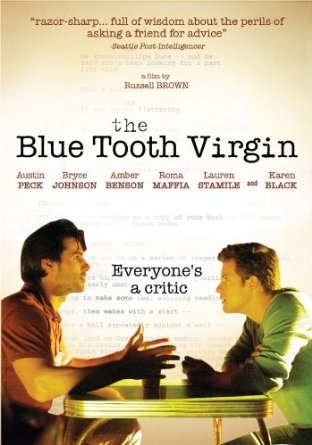


As I watched Russell Brown’s new film, The Blue Tooth Virgin, the hairs on the back of my neck stood up as I faced on screen the insecurities and dark heart of writers everywhere. That it made me squirm in my seat proves that whatever flaws others may perceive in it, Brown honestly examines his subject matter. What starts off as a lean comedy poking fun at Hollywood culture gradually shifts into a deeper meditation on truth and ego as characters dissect their inner motivations and face their lurking desires heretofore tucked away from all, including themselves. Hitting theaters now courtesy of Regent Releasing, The Blue Tooth Virgin is a solid, character driven piece based on substance over style.
The film’s narrative weight is shouldered by Sam, an unproduced screenwriter pining for success after his canceled television show and David, a stylish, witty magazine editor who is also Sam’s friend. The seed that unleashes this Bergmanesque angst fest is quite simple; Sam has a new screenplay that he’s getting ready to shop around town and wants David to read it for his thoughts. Now this is a loaded situation for anyone who has an artistic friend who requests your opinion on their work, if you’re brutally honest then you’re perceived as an unsupportive enemy or else you’re simply massaging their ego and suppressing your own principles. If you want further reading on this subject, simply peruse screenwriter Josh Olson’s recent blog for The Village Voice entitled, “I Will Not Read Your Fucking Script”.
Suffice it to say, David does not enjoy Sam’s quirky, Lynchian story about a woman who “morphs” into different people while trying to solve a childhood mystery with the aid of a mute detective and hermaphrodite hypnotist. He debates the merits of honesty versus friendship with a fellow colleague over some pot and ultimately decides to be forthright with his opinion. Sam, in turn, assails David with insults over his tawdry magazine writing, degrading it as nonessential to an “artist” such as himself. This small but quickly venomous disagreement forms an ever-widening chasm in these men’s lives as they are confronted in the following episodic scenes by loved ones and colleagues who call them out on their ego-massaging, hypersensitive, “artistic” posturing and aspirations. Both men desire the glory and admiration afforded by the arts without being interested in the actual work needed to gain it. Whether it is Sam’s wife confronting his incessant need to feel superior above others instead of enjoying the writing process or David’s therapist shooting down his own screenwriting efforts for the adulation gained by being a successful, produced “serious” writer, each man is confronted to rip away their self-serving but pragmatic veils.
In its own way, The Blue Tooth Virgin is a twenty-first century successor to The Iceman Comethor Who’s Afraid of Virginia Woolf if I may be so bold. Each one confronts the paradoxical dangers and necessity of self-illusion in one’s life. Shot on what must have been a shoestring budget (by Hollywood terms certainly), Brown fashions the film as essentially a succession of solid, two-handers that would be just as effective on a small, black box stage as they are in a proper cinema setting. Directorial flash is set aside to focus clearly on the characters constant give and take as they probe each other via the incisive dialogue. If I had any major criticism, it would be that Brown should have put this project up as a live theatrical production rather than a film. The film’s visual paucity would be quickly nullified by quietly observing these characters on a near-bare stage having it out with each other, in front of a live audience that hopefully would have a few writers squirming in their seats as I did in mine.
For more information on this film, go to www.thebluetoothvirgin.com